


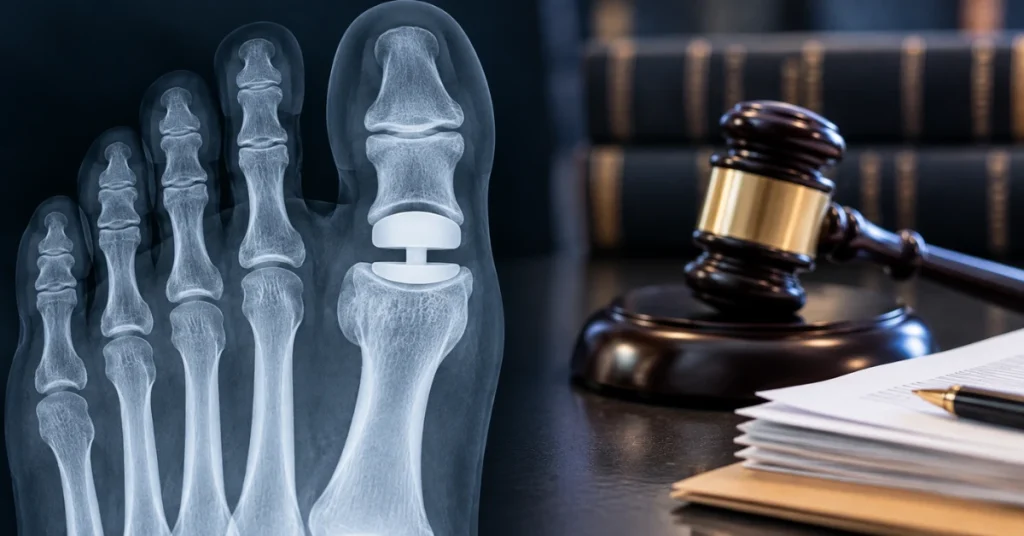
As of October 2026, no Cartiva lawsuit settlement program has been announced and no settlement amounts have been made public, so any dollar figure you see online is a projection rather than a payout. What a Cartiva claim is worth depends on your own records: how badly the implant failed, whether you needed revision or fusion surgery, how many operations you have had, and what the injury has cost you in income and mobility.
That second sentence carries more weight than it looks. Two people with the same failed implant can end up with very different claims, because a fusion is not a revision, a warehouse supervisor is not a remote bookkeeper, and a well-documented timeline is not a shoebox of loose paperwork. Early test trials in the federal litigation will also shape every negotiation that follows. Most settlement pages skip the part that matters most right now, which is the part you can still control.
If your Cartiva implant failed and you are trying to understand what your losses could mean in a claim, a free Cartiva case review with a board-certified civil trial lawyer can look at your surgical records, your work history, and your timeline and tell you honestly where you stand. It costs nothing, and there is no fee unless we recover. Below, we walk through how damages are evaluated so you know exactly what that review will be looking for.
Why Can’t Anyone Tell You a Cartiva Settlement Amount Yet?
No one can give you a reliable Cartiva settlement amount yet because the numbers that would anchor one do not exist. There is no global settlement program, no published settlement schedule, and no bellwether verdict in the federal litigation.
Federal Cartiva cases were consolidated on February 5, 2026, into MDL No. 3172 in the United States District Court for the Eastern District of Arkansas. The litigation is still in its pretrial stage, where the court sets the rules for evidence gathering and case management before any test trial is scheduled.
So where do the ranges on other websites come from? They are estimates built on assumptions:
- Which older medical device cases the author treats as comparable
- How severe the author assumes a typical claim will be
- How many claimants the author assumes will share in a resolution
- Trial dates or claim counts that may no longer match the court record
Change any one of those assumptions and the range moves. That is why two projections can disagree with each other and still both be called estimates. For where the case stands procedurally right now, see our Cartiva lawsuit update, which tracks the MDL docket.
What you can understand today is how value gets built. That is the rest of this guide.
What Damages Can a Cartiva Claim Include?
Cartiva compensation can include economic damages, non-economic damages, and, depending on your state, a spouse’s claim and punitive damages. Each category covers a different kind of loss, and most strong claims involve more than one.
Economic Damages
Economic damages are the losses you can add up with records. In a Cartiva claim, these commonly include:
- The cost of the original implant procedure that allegedly failed
- Revision surgery, implant removal, or fusion surgery
- Imaging, specialist visits, injections, and pain management
- Physical therapy and rehabilitation
- Future medical care your doctors expect you to need
- Wages lost during surgery and recovery
- Reduced ability to earn in the future, often called lost earning capacity
- Out-of-pocket costs such as travel to appointments, orthotics, and help at home
Non-Economic Damages
Non-economic damages cover harm that does not come with a receipt. That includes physical pain, the loss of motion in the big toe joint, the activities you can no longer do, and the frustration of undergoing more surgery after a procedure that was supposed to fix the problem.
These damages are real, but they need evidence too. Medical notes, your own consistent descriptions of symptoms, and testimony from people who know you all help show what changed.
Spousal and Punitive Damages
In many states, a spouse can bring a separate claim for loss of consortium, meaning the effect the injury had on the marriage and household. Punitive damages, which are meant to punish especially serious misconduct, are allowed only in some situations and carry a higher standard of proof. Both depend heavily on which state’s law applies.
For how these categories work across product injury cases generally, including watercraft defects, see our guide on when medical devices and watercraft defects fail. This page stays focused on how they apply to Cartiva.
What Factors Raise or Lower the Value of a Cartiva Claim?
The value of a Cartiva claim rises with how severe, how permanent, and how well documented the harm is, and it falls when records are thin or something else could explain the symptoms. No single factor decides it. The combination does.
A note on framing: the lawsuits allege that the Cartiva implant was defectively designed and that its risks were not adequately disclosed. The manufacturers deny these allegations, and causation has not been decided in court. The factors below describe how a claim is evaluated, not a finding that any device caused any specific injury.
How Badly Did the Implant Fail?
The nature of the failure matters. The FDA’s Class 2 recall record for the Cartiva implant lists hazards including revision, removal, implant subsidence, displacement, pain, nerve damage, and fragmentation.
Claims tend to be stronger when imaging or an operative report documents what happened to the implant, rather than relying on symptoms alone. A surgeon’s written description of a sunken, shifted, or broken implant is the kind of objective evidence that carries weight.
Did You Need Revision or Fusion Surgery?
Surgery to remove or replace a failed implant is one of the clearest markers of harm, and fusion surgery generally reflects a more serious and permanent outcome than revision alone. Fusion eliminates motion in the joint, which is the very outcome many patients chose Cartiva to avoid.
We cover what fusion means medically and legally in our guide to Cartiva implant failure symptoms, revision, and fusion, including what compensation may be available for fusion surgery costs.
How Many Surgeries Have You Had?
Each additional procedure adds medical cost, recovery time, missed work, and pain. A patient who went from implant to revision to fusion has a longer and more expensive history than a patient who had one corrective surgery, and that history shows up directly in the damages.
Is Your Loss of Mobility Permanent?
Permanence changes the math. If your doctors expect stiffness, altered walking, balance problems, or pain to continue for the rest of your life, the claim has to account for every year ahead, not just the months already behind you.
Age plays a role here. A younger patient may live with a permanent limitation for decades, which affects both future medical needs and the non-economic side of the claim.
What Has the Injury Cost You Out of Pocket?
Deductibles, copays, prescriptions, specialized footwear, mileage to appointments, and paid help with chores all count. These costs are easy to forget and easy to prove if you kept the paperwork. Many people underestimate this category until they start adding it up.
What Could Lower the Value of a Claim?
An honest evaluation also looks at what the defense will argue. Common pressure points include:
- Other foot conditions or prior injuries that could explain the symptoms
- Long gaps in treatment that make the timeline harder to follow
- Missing records, especially operative reports and imaging
- Inconsistent descriptions of symptoms across different providers
- Filing timing problems under your state’s deadline rules
None of these automatically defeats a claim. Knowing about them early is what lets a lawyer address them.
How Does Your Job Affect What a Cartiva Claim Is Worth?
Your job can be one of the biggest drivers of a Cartiva claim’s value, because the big toe joint is involved in nearly every step you take. When a failed implant limits standing and walking, people whose work depends on their feet often lose the most.
Consider two patients with the same fusion surgery. One works remotely at a desk and returns to work within weeks. The other is a nurse on twelve-hour shifts who cannot return to the floor and has to retrain for a different role. Same surgery, very different losses.
Occupations where this often comes up include:
- Nurses, medical assistants, and other hospital staff
- Teachers and childcare workers
- Retail, restaurant, and hospitality workers
- Warehouse, delivery, and logistics workers
- Construction and skilled trades
- Law enforcement, firefighters, and other first responders
Two kinds of losses are in play. Lost wages cover the time you have already missed for surgery and recovery. Lost earning capacity covers the income you are unlikely to earn in the future because of permanent restrictions, including a forced move to lower-paying work or early retirement.
Proving these losses takes paperwork: pay stubs, tax returns, letters from your employer, and written work restrictions from your doctor. If you are self-employed, invoices and business records can show the income you lost while you could not work.
Why Do Your Own Records Set Your Number in a Mass Tort?
In a mass tort, each person keeps an individual claim, so its value is built from that person’s own medical and financial records rather than a group average. The MDL shares the evidence gathering. It does not pool the compensation.
When large medical device litigations have resolved through settlement, the programs have often sorted claimants into categories based on documented facts, such as the type of surgery, the number of procedures, how soon after implantation the failure occurred, and the claimant’s age. Your records decide which category you land in and what adjustments apply.
That is why averages mislead. An average blends patients with mild symptoms and patients with multiple surgeries into one figure that describes almost nobody. If your file shows fusion, two revisions, and a career change, an average undersells you. If your file is thin, an average may oversell what the records can support.
Robert B. Baker has seen this structure firsthand. He served as State Liaison Counsel for Rhode Island in the defective breast implant multidistrict litigation, coordinating claims across states. The lesson carries over directly: the claimants with complete, organized records are the ones positioned to be valued accurately.
For the structural difference between an MDL and a class action, and what each means for the Cartiva cases, see our Cartiva lawsuit update.
How Do Bellwether Trials Shape Cartiva Settlement Talks?
Bellwether trials are early test cases, and their outcomes give both sides a real-world signal of how juries respond to the evidence. That signal becomes the reference point for settlement negotiations across the whole MDL.
Here is how the mechanism works:
- The court selects a small group of cases meant to represent the broader set of claims.
- Those cases go to trial in front of juries, who hear the evidence on the design and warning allegations.
- Strong plaintiff results tend to increase pressure on the defense to resolve the remaining cases. Defense results tend to do the opposite.
- Results across different injury types, such as revision versus fusion, help both sides put a value on each category of claim.
Your case does not have to be selected for a bellwether trial to be affected by one. Its outcome can shape the starting point for discussions about cases like yours.
MDL No. 3172 is overseen by Chief Judge Kristine G. Baker of the Eastern District of Arkansas. Judge Kristine G. Baker is not related to Robert B. Baker of Baker Legal Team. No bellwether schedule has been set as of this writing, and the timing of any test trials will depend on the court’s case management orders.
Does Having a Trial Lawyer Change How a Claim Is Valued?
Settlement value reflects what the defense believes a jury might do, so a lawyer who is prepared to try the case changes the calculation on the other side of the table. Defendants track which firms settle by default and which ones go to court.
Robert B. Baker has been a Board Certified Civil Trial Lawyer with The Florida Bar since 2002, a credential held by fewer than 1% of Florida attorneys. Over more than 30 years he has tried product liability cases to verdict, including jury verdicts against personal watercraft manufacturers Bombardier and Yamaha, and argued Lamz v. Geico before the Florida Supreme Court. His work on medical device claims includes his role as State Liaison Counsel in the breast implant MDL.
That record is leverage, not a promise. It tells a defendant that a low offer may be tested in front of a jury. It does not guarantee any particular result in your case, and no honest lawyer would tell you otherwise. You can read more about Robert B. Baker’s background and trial record.
Past results do not guarantee future outcomes. Every case is evaluated on its own facts.
What Does the Free Case Review Look At When Valuing a Cartiva Claim?
A free Cartiva case review looks at the documents that show what the implant failure has cost you. The goal is to understand which value factors apply to your situation, not to give you a number on the first call.
Expect the review to cover:
- Proof that you received a Cartiva implant, such as the operative report or device label from the original surgery
- Imaging that shows the condition or position of the implant
- Operative reports from any revision, removal, or fusion surgery
- The timeline of symptoms, treatment, and surgeries
- Work restrictions, missed time, and changes to your job or income
- Out-of-pocket medical and household costs
- How the injury has changed your daily life
- How your state’s filing deadline applies to your timeline
You do not need every document before you call. Part of the review is figuring out what is missing and how to get it.
If you are still asking the earlier question of whether you qualify at all, start with our guide on who qualifies for a Cartiva lawsuit. When you are ready to talk through your own records, request a free Cartiva case review.
What Can You Do Now to Protect the Value of Your Claim?
The most valuable thing you can do right now is protect the evidence and document your losses as they happen. Value that is never recorded is hard to recover later.
- If you are facing revision or fusion surgery, ask in writing that the removed implant be preserved. Our guide to Cartiva implant records and evidence explains how.
- Request copies of your operative reports, imaging, and treatment notes from every provider.
- Keep every bill, receipt, and explanation of benefits in one place.
- Record each day of work you miss and save any written restrictions from your doctor.
- Keep a short weekly note on pain, mobility, and activities you had to give up.
- Do not sign a release or accept a direct payment from a manufacturer, hospital, or insurer without legal advice. It may end your claim.
- Find out how your filing deadline applies. Our guide to Cartiva lawsuit filing deadlines explains when the clock starts.
- Talk with a lawyer before key decisions are made for you. You can contact Baker Legal Team any time for a free conversation.
Bottom Line
No Cartiva lawsuit settlement amounts exist yet, and any number you see online is a projection. What will matter is your own file: the severity of the failure, the surgeries you needed, whether the damage is permanent, and what it has cost your work and daily life.
In a mass tort, your records set your number, and bellwether trials will shape the starting point for negotiations. The steps you take now to preserve evidence and document your losses are what put you in position to be valued accurately when that happens.
If your implant failed, a free Cartiva case review can tell you which of these factors apply to you. There is no cost and no fee unless we recover.
Frequently Asked Questions
What is the average Cartiva lawsuit settlement?
There is no average Cartiva lawsuit settlement because no settlement program has been announced and no settlement amounts have been made public. Any average you see is an estimate based on assumptions. Your own claim will be valued on your medical records, surgeries, and financial losses.
Will everyone in the Cartiva MDL receive the same amount?
No, everyone in the Cartiva MDL will not receive the same amount. Each person keeps an individual claim, and its value depends on that person’s documented injuries, number of surgeries, and losses. Someone who needed fusion and changed careers would be evaluated very differently from someone with a single revision.
Can a Cartiva claim include the cost of future surgery?
Yes, a Cartiva claim can include the cost of future surgery if your doctors expect you to need it. Future medical care is part of economic damages, and it is usually supported by a treating physician’s opinion about what treatment lies ahead.
Can I be compensated if I had to change jobs because of my implant?
Yes, you may be compensated if you had to change jobs because of your implant, through a claim for lost earning capacity. This covers future income you are unlikely to earn because of permanent restrictions. Pay records, tax returns, and written work restrictions help prove it.
Can my spouse be compensated in a Cartiva claim?
Your spouse may be able to be compensated in a Cartiva claim through a loss of consortium claim, depending on your state’s law. This type of claim covers how the injury affected your marriage and household. Whether it applies is one of the questions a lawyer can answer during a case review.
Are punitive damages possible in a Cartiva lawsuit?
Punitive damages are possible in a Cartiva lawsuit only in some circumstances, and the rules vary by state. They require proof of especially serious misconduct, which is a higher standard than ordinary compensation. Because the manufacturers deny the allegations and nothing has been decided in court, no one can say yet whether punitive damages will play a role.
Does it cost anything to have my Cartiva claim evaluated?
No, it does not cost anything to have your Cartiva claim evaluated by Baker Legal Team. The case review is free, and if you move forward, there is no fee unless we recover. You can start with as much or as little paperwork as you have.