


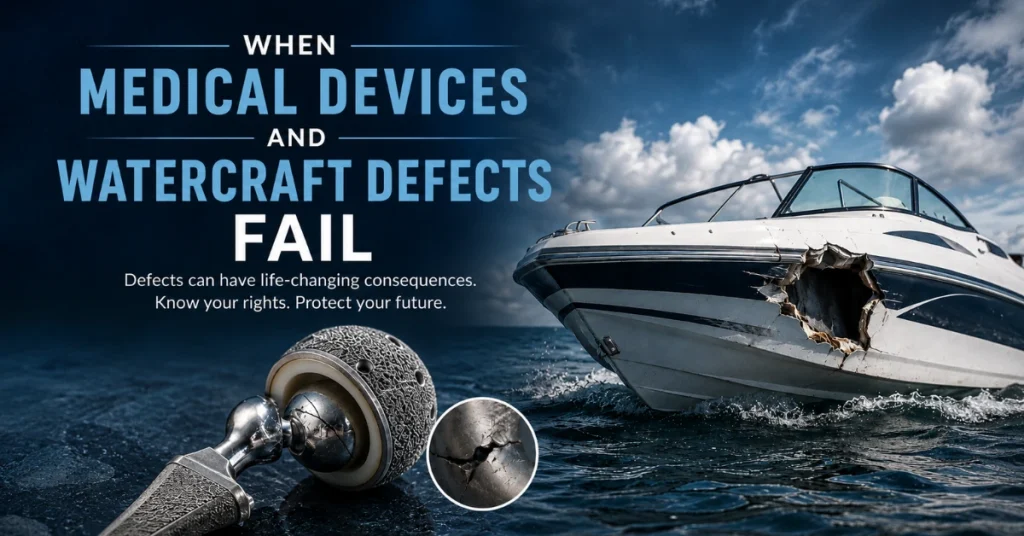
A medical device or a piece of watercraft is considered legally defective when it fails to perform as safely as an ordinary user would reasonably expect, or when a safer design was available and the manufacturer chose not to use it. This standard applies whether the product is a synthetic cartilage implant cleared by the FDA or a personal watercraft built to standard marine specifications.
That sounds simple, but the nuance is where most injured people get stuck. FDA clearance, industry certification, and “everyone else builds it this way” are not the same as safe, and proving a design defect requires different kinds of evidence depending on whether the product is a medical device or a mechanical one. This article breaks down exactly what that evidence looks like in each case, and why the two categories share more legal DNA than most people assume.
If you’re trying to figure out whether a failed Cartiva toe implant or a watercraft accident involving loss of steering qualifies as a defective product claim, Robert Baker has taken on manufacturers in both categories and won, including a record $39 million jury verdict against a personal watercraft maker. A free case review can tell you where your situation stands.
What Makes a Medical Device or Watercraft Legally Defective?
A product is legally defective when its design, manufacturing, or warnings create an unreasonable risk of harm during normal, foreseeable use. Courts generally look at three categories of defect: design defects, manufacturing defects, and failure-to-warn defects.
A design defect means the product itself was built in a way that made it dangerous, even when made correctly and used as intended. This is different from a one-off manufacturing flaw, and it is different from simply not warning users about a known risk.
Most Cartiva implant claims and most watercraft steering claims are design-defect cases. The allegation is not that one unit was built wrong. The allegation is that the entire product line shares a flaw.
Key elements a product liability case typically has to establish:
- The product had a defect (design, manufacturing, or warning)
- The defect existed when the product left the manufacturer’s control
- The defect caused the injury
- The product was being used in a way the manufacturer could reasonably foresee
Does FDA Clearance Protect a Device Maker From a Lawsuit?
FDA clearance does not automatically protect a device manufacturer from a defect lawsuit. Clearance means the agency allowed the product to be marketed, not that the agency guaranteed it was free of design flaws.
This confuses a lot of people, understandably. If a federal agency reviewed the device, it feels like the safety question should already be settled.
In practice, the FDA’s 510(k) clearance pathway, which covers many implanted devices, largely reviews whether a new device is “substantially equivalent” to a product already on the market. It is not the same as full pre-market approval, and it does not test long-term real-world failure rates the way years of patient outcomes eventually do.
That gap between clearance and real-world performance is exactly what shows up in Cartiva implant litigation. Reported complications, including implant loosening, shrinkage, persistent pain, and the need for revision or fusion surgery, are the kind of post-market evidence that can support a design-defect allegation, even though the device was cleared before those patterns emerged. It is important to be clear here: these are allegations made in ongoing litigation, the manufacturer disputes them, and causation has not been decided in court.
Why Doesn’t Meeting an Industry Standard Stop a Watercraft Defect Claim?
Meeting an industry standard does not automatically shield a watercraft manufacturer from liability, especially if the standard itself lagged behind known safety data. Compliance with a voluntary standard is evidence a manufacturer can point to, but it is not an automatic defense.
Personal watercraft, commonly called jet skis, are a clear example. For years, many models were built without off-throttle steering, meaning that once a rider released the throttle to avoid a collision, the craft lost all steering ability. Riders describe it as the equivalent of a car’s steering locking straight ahead the moment you lift your foot off the gas.
The industry eventually responded. SAE Recommended Practice J2608, covering off-throttle steering capability, was issued in 2003. But that standard came only after years of documented accidents and after litigation, including cases against Yamaha, put real pressure on manufacturers to redesign.
Robert Baker’s case, Archer and Perez v. Yamaha, resulted in a $39 million jury verdict, the largest ever against a personal watercraft manufacturer, on the theory that the craft was defectively designed because it lacked off-throttle steering. That verdict is widely credited with accelerating industry-wide design changes.
What Cartiva Implant Failures and Watercraft Steering Defects Have in Common
Despite belonging to completely different industries, both categories of claim rest on the same core legal question: did a safer, feasible design exist, and did the manufacturer choose not to use it? That question doesn’t change based on whether the product goes inside a body or under a boat hull.
Both categories also share a pattern of manufacturers pointing to regulatory approval or industry compliance as if it settles the safety question. And both categories tend to move slowly, through individual filings that eventually consolidate into coordinated litigation, such as an MDL, as more injured people come forward.
This is why the same product liability skill set applies to both. A lawyer handling these cases has to be comfortable working with:
- Engineering and design experts (mechanical failure analysis, hydrodynamics)
- Medical and biomechanical experts (implant materials, failure mechanisms, revision surgery outcomes)
- Regulatory history (FDA clearance records, SAE and CPSC standards)
- Prior incident and complaint data showing the manufacturer had notice of the risk
Robert Baker’s record includes both sides of that skill set: the watercraft verdict against Yamaha, and product liability work across defective medical devices and pharmaceutical products, including active review of Cartiva toe implant cases.
How Product Liability Lawyers Prove a Defect Case
Proving a design defect case generally follows a consistent process, regardless of whether the product is a medical implant or a piece of machinery.
- Case evaluation. A lawyer reviews medical records, surgical reports, or accident details to determine whether the injury pattern matches a known or suspected defect.
- Evidence preservation. For implants, this can mean helping a client preserve the removed device after revision surgery. For watercraft, this means securing the craft, maintenance records, and any available surveillance or witness accounts.
- Expert retention. Engineers, biomechanical specialists, or marine safety experts analyze the product and compare it against feasible alternative designs.
- Discovery. Internal manufacturer records, prior complaint data, and design history are obtained, often revealing what the manufacturer knew and when.
- Filing and, where applicable, consolidation. Individual cases may be filed and, if enough similar claims exist, consolidated into an MDL for coordinated pretrial proceedings.
- Resolution. Cases resolve through settlement or trial, depending on the strength of the evidence and the manufacturer’s posture.
What Compensation May Be Available After a Defective Product Injury
Compensation in a product defect case typically covers medical expenses, lost wages, pain and suffering, and, in the most serious cases, long-term disability or wrongful death damages. The exact value depends heavily on the severity and permanence of the injury.
For a Cartiva implant claim, this can include the cost of revision or fusion surgery, ongoing mobility limitations, and pain from a device that did not perform as expected. For a closer look at how those losses are weighed, see our guide to what a Cartiva claim is worth.
For a watercraft defect claim, damages can include catastrophic injury costs, such as traumatic brain or spinal injuries, or wrongful death damages when a defect contributes to a fatal accident.
Past results, including the $39 million watercraft verdict referenced above, do not guarantee a particular outcome in any other case. Every claim is evaluated on its own facts.
Bottom Line
Whether the product is a toe implant or a jet ski, the legal question is the same: was there a safer design available, and did the manufacturer use it? FDA clearance and industry standards matter, but neither one automatically clears a manufacturer of responsibility. If a Cartiva implant failed or a watercraft accident involved a loss of steering control, that pattern is worth having reviewed by a lawyer who has litigated design-defect claims in both categories.
Robert Baker offers free, no-obligation case reviews for both Cartiva implant and watercraft defect claims, with no fees or costs unless he wins.
Frequently Asked Questions
Is a Cartiva toe implant lawsuit the same as a product liability case?
Yes, a Cartiva toe implant lawsuit is a type of product liability case, specifically a design-defect claim alleging the synthetic cartilage implant was prone to premature failure, loosening, or the need for revision surgery.
Does FDA clearance mean a medical device is safe?
No, FDA clearance does not mean a medical device is safe in every case, since clearance often reviews substantial equivalence to existing products rather than long-term real-world performance.
What is off-throttle steering, and why does it matter in a lawsuit?
Off-throttle steering is the ability to steer a personal watercraft after releasing the throttle, and it matters in a lawsuit because many older watercraft models lacked it entirely, leaving riders unable to avoid a collision once they let go of the throttle.
Can I still file a claim if there hasn’t been a global settlement yet?
Yes, you can still file a claim if there hasn’t been a global settlement yet, since individual lawsuits and coordinated litigation such as an MDL typically proceed well before any settlement framework is reached.
How do I know if my watercraft accident involved a design defect?
You may know your watercraft accident involved a design defect if the craft lost steering ability after the throttle was released, lacked adequate warnings about that risk, or if similar incidents have been reported involving the same make and model.
What evidence should I preserve after a Cartiva implant failure or a watercraft accident?
You should preserve medical records, surgical and revision reports, or the physical implant itself for a Cartiva claim, and the watercraft, maintenance records, and any photos or witness information for a watercraft accident.
Do these cases settle, or do they go to trial?
These cases can settle or go to trial, depending on the strength of the evidence and the manufacturer’s willingness to resolve claims, and having a trial-tested lawyer matters most when a manufacturer refuses to negotiate fairly.