


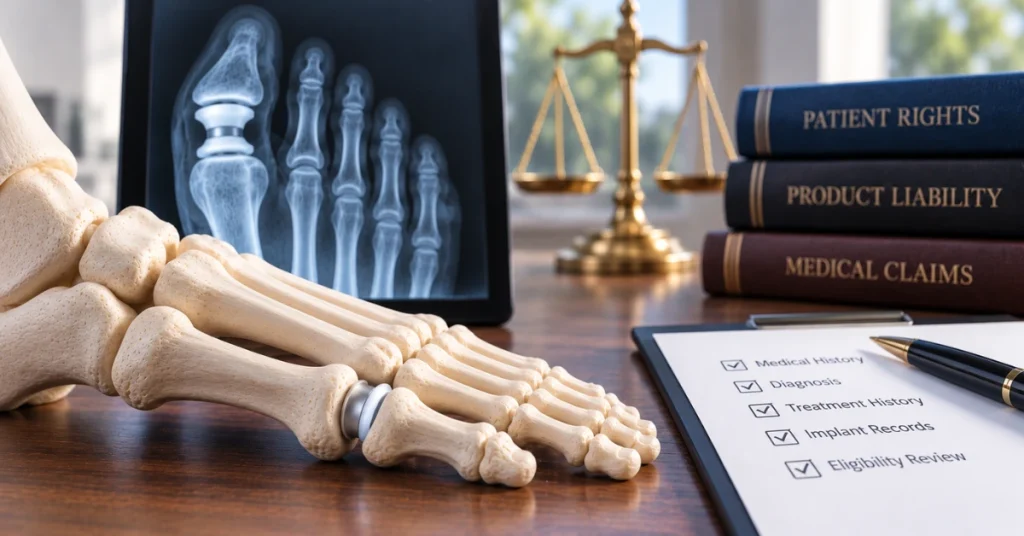
In general, you may qualify for a Cartiva lawsuit if you received a Cartiva Synthetic Cartilage Implant and later experienced complications such as ongoing pain, implant failure, or the need for revision or fusion surgery. There is no single checklist that determines eligibility on its own. It depends on the specific facts of your implant, your treatment history, and your state’s filing deadline.
A lot of people rule themselves out for reasons that do not actually matter. They assume they need to have already had revision surgery, or that too much time has passed, or that their paperwork has to say “Cartiva” in plain text before anyone will look at their case. None of that is necessarily true, which is exactly why a free case review, rather than a self-assessment, is the reliable way to find out where you stand.
Baker Legal Team offers a free Cartiva toe implant lawsuit consultation to evaluate your situation, with no fees and no costs unless we win. Here is how eligibility for a Cartiva claim generally works, question by question.
Who Is Being Evaluated for a Cartiva Lawsuit?
Broadly, anyone who received a Cartiva Synthetic Cartilage Implant and later experienced complications is a candidate for evaluation. This generally includes patients who developed ongoing pain, stiffness, implant displacement or subsidence, or who required additional treatment beyond the original implant procedure. If you are not sure whether your symptoms fit this pattern, our breakdown of Cartiva implant failure rates and what the data actually shows covers the reported warning signs in more detail.
Cartiva claims allege that the device was defectively designed and that patients were not adequately warned about the risk of failure. These are allegations made in ongoing litigation. The manufacturer disputes them, and causation has not been decided by any court. That does not change whether your situation is worth evaluating. It simply means the outcome of any individual claim depends on the specific facts, not on a general statement about the device.
Baker Legal Team publishes the general criteria it looks at when reviewing a new Cartiva case on the firm’s Cartiva lawsuit update, under the heading covering what the firm confirms before taking a case. The sections below go further into what each of those criteria actually means in practice, and where the common misconceptions tend to come from.
Does the October 2024 Recall Affect Your Eligibility?
The recall itself does not automatically make you eligible or ineligible. What it does is support the broader pattern behind the current litigation. Stryker issued a Class II recall for the Cartiva implant on October 31, 2024, covering devices distributed from July 2016 through October 2024, citing higher than expected rates of revision surgery, removal, and subsidence.
If your implant falls within that distribution window, the recall is relevant background for your claim. If you are not certain when your implant was placed or which device you received, that is a records question rather than an eligibility barrier, and it is one a case review can help sort out.
It is also worth understanding what the recall is not. A Class II recall designation is not, by itself, a finding of legal liability, and it does not automatically entitle every patient who received the device to compensation. It reflects the FDA’s determination that the device may cause certain adverse health consequences at a higher rate than expected. Whether that translates into a viable individual claim still depends on your own treatment history and documented complications, not on the recall notice alone.
Why Is Revision or Fusion Surgery Often the Pivot Fact?
Revision or fusion surgery is often the clearest evidence that an implant failed, which is why it tends to be a significant fact in evaluating a claim. A documented need for additional surgery generally provides a concrete medical record showing that the original implant did not perform as expected, along with imaging, an operative report, and a treating surgeon’s own assessment of what went wrong.
This matters practically because it converts something subjective, how much pain you have been in, into something a claim can point to directly: a second procedure, a specific diagnosis, and a paper trail generated by your own medical team rather than by you. That is not a comment on whether pain alone is a legitimate reason to seek care or to explore a claim. It is simply an observation about which kinds of facts tend to be easiest to document and evaluate quickly.
That does not mean revision surgery is the only path to a claim, a point covered in the next section. For a closer look at what typically happens medically when a Cartiva implant fails, including the difference between revision and fusion surgery, see Cartiva implant failure: what happens next, and what it means for fusion surgery and your legal options.
Do You Need to Have Had Revision Surgery to File?
No, you do not strictly need to have had revision surgery to explore a Cartiva claim. Ongoing pain, documented subsidence or displacement on imaging, and other complications short of a full revision can also be relevant, depending on how well they are documented and how clearly they connect to the implant.
What matters is whether there is a documented medical basis connecting your symptoms to the implant, not whether you have already undergone a specific procedure. A claimant who has not yet had revision surgery but has clear imaging and a documented symptom history is not automatically excluded. This is worth stating plainly, since it is one of the most common reasons people wrongly assume they do not qualify.
What Does Not Disqualify You?
A number of assumptions keep people from reaching out when they otherwise might have a claim worth reviewing. None of the following automatically disqualifies you:
- Living outside Florida. Baker Legal Team evaluates Cartiva claims nationwide, not only for Florida residents.
- Not having your records gathered yet. A records checklist, and how to request what you need, is covered separately in our guide to Cartiva implant records and evidence.
- Being unsure of the exact device name on your paperwork. Corporate ownership of the device changed hands twice, and records sometimes reference Wright Medical or Stryker rather than Cartiva directly.
- Having symptoms but not yet having had surgery. As covered above, revision or fusion surgery is common in these claims but is not a strict requirement.
- Already having another attorney look at your case in the past, whether that attorney is still actively representing you or not, if your claim was never actually filed.
- Assuming too much time has passed. Filing deadlines are frequently measured from when a problem was discovered, not from the date of the original implant. For a full breakdown of how these deadlines work, see our guide to Cartiva lawsuit filing deadlines.
If you are unsure whether one of these applies to you, that uncertainty is itself a reason to get a free case review rather than deciding on your own that you do not qualify. Ruling yourself out based on an assumption costs nothing to avoid, since the case review itself is free either way.
What Does a Free Case Review Actually Assess?
A free case review generally looks at a few specific things: whether your implant and treatment history are consistent with the allegations at the center of the current litigation, what documentation currently exists to support a claim, and how your state’s filing deadline applies to your specific timeline. It is a fact-gathering conversation, not a guarantee of acceptance or a prediction of outcome.
During that conversation, expect to be asked about when and where your implant was placed, what symptoms or complications you experienced and when they began, whether you have had or are considering revision or fusion surgery, and what records you already have versus what might need to be requested. None of these questions are designed to disqualify you on the spot. They are designed to build an accurate picture of your situation so the firm can tell you honestly whether it looks like a case worth pursuing.
No attorney can promise that a case will be accepted or how it will resolve before reviewing the specific facts, and Baker Legal Team does not make that promise here. What the firm can offer is a straightforward, no-cost evaluation of where your situation currently stands, without pressure to commit to anything as a result of that conversation.
What Should You Do Next?
If you received a Cartiva implant and have experienced ongoing pain, complications, or the need for additional surgery, the most direct next step is a free consultation with Baker Legal Team, with no fees and no costs unless we win.
There is no obligation attached to that conversation, and reaching out does not commit you to filing anything. If you are still weighing which firm to trust with your claim, our guide on how to choose a Cartiva lawyer covers the questions worth asking any firm before you sign.
The firm reviews Cartiva claims nationwide on a contingency fee basis. Every case is different, and the facts described throughout this article about the allegations behind the Cartiva litigation are disputed by the manufacturer, with causation not yet decided by any court. A free case review is the way to find out how those general facts apply to your specific situation. Contact Baker Legal Team today for your free consultation.
Frequently Asked Questions
Do I qualify if I haven’t had revision surgery yet?
You may still qualify for a Cartiva claim even if you have not had revision surgery yet. Documented complications and imaging showing implant issues can be relevant, though a free case review is the most reliable way to know where you stand.
Does it matter which state I live in?
Your state matters for which filing deadline applies to your claim, but it does not disqualify you from a case review. Baker Legal Team evaluates Cartiva claims from patients nationwide, not only in Florida.
What if I’m not sure I had a Cartiva implant specifically?
If you are not sure you had a Cartiva implant specifically, your operative report and surgical records can generally confirm this, and the device may be documented under the name Wright Medical or Stryker depending on when your surgery occurred. A case review can help you sort this out.
Does a free case review obligate me to anything?
No, a free case review does not obligate you to anything. It is a no-cost, no-pressure conversation to evaluate your situation, and there are no fees or costs unless Baker Legal Team wins your case.
This article provides general information about Cartiva lawsuit eligibility and does not constitute legal advice or a guarantee of case acceptance or outcome. Every claim depends on its specific facts. The allegations described above regarding the Cartiva Synthetic Cartilage Implant are disputed by the manufacturer, and no court has determined causation. Contact Baker Legal Team for a free consultation, with no fees and no costs unless we win.