


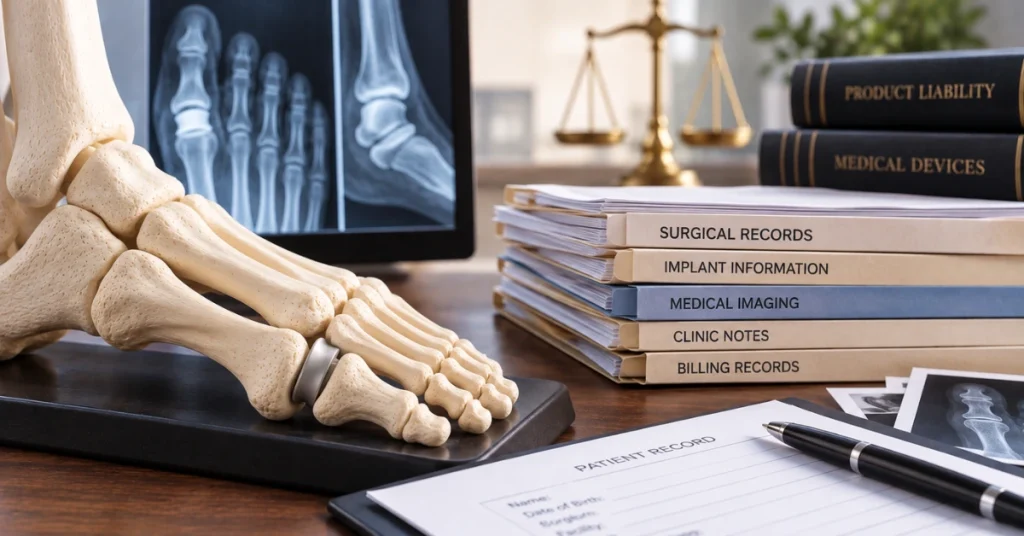
If you are heading toward revision or fusion surgery after a Cartiva implant, there are two things most patients do not realize until it is nearly too late. The first is that many people cannot say with certainty which implant they actually received, since the paperwork does not always say “Cartiva” in plain language. The second is that the device itself, once removed, is treated by most hospitals as medical waste and discarded as a matter of routine, unless someone specifically asks otherwise.
Both of these are fixable, but only with a window that closes fast. A legal deadline gives you months or years to sort things out. The physical device does not wait. Once it is gone, it is gone, and with it goes a piece of evidence that can matter to your claim.
This is not medical advice, and nothing here should change a decision you make with your surgeon about your treatment. It is a records and evidence checklist, meant to run alongside your medical care and your free Cartiva toe implant lawsuit case review, not in place of either. Here is what to confirm, what to request, and what to hold onto.
How Do You Confirm You Received a Cartiva Implant?
The most reliable source is your operative report, sometimes called the operative note, from the surgery where the implant was placed. This document, generated by your surgeon at the time of the procedure, typically identifies the specific device used, including a device identifier or lot number tied to the manufacturer’s packaging.
A few places to look and ask:
- The operative report itself, which your surgeon’s office or the hospital’s medical records department can provide.
- The implant sticker or device identifier that is often placed directly in your surgical chart at the time of the procedure, separate from the narrative operative note.
- The manufacturer label from the device packaging, which some practices scan into the patient file.
- Your hospital’s implant registry, if one exists, which some facilities maintain for tracking implanted devices.
If you are not sure where to start, the most direct approach is a written medical records request to your surgeon’s office or the hospital where the procedure took place, specifically asking for the operative report and any implant identification documentation for that surgery. Most practices have a standard records request form, though you can also request records in a simple written letter that names the procedure date and the specific documents you need.
It helps to be specific in that request rather than asking generally for “my medical records.” Naming the operative report, the implant or device identifier, and the surgery date directly tends to get a faster, more complete response than a broad request, which some offices interpret narrowly and may not include every relevant document on the first pass. If a first request comes back incomplete, a brief written follow-up naming exactly what is still missing is generally more effective than resubmitting the same broad request a second time.
Why Might Your Paperwork Say Wright Medical or Stryker Instead of Cartiva?
If your records reference a manufacturer other than Cartiva, that does not necessarily mean you received a different device. Cartiva, Inc. developed the implant and received FDA clearance for it in 2016. Wright Medical Group acquired Cartiva in 2018, and Stryker Corporation acquired Wright Medical in 2020, later issuing the recall in October 2024 under the Stryker name.
Depending on when your surgery took place, your paperwork, invoices, or device labeling may reference any of these three companies, since the corporate ownership changed twice over the years the device was on the market. This is worth knowing before you search your own records, since looking only for the word “Cartiva” can cause you to miss documentation that references the device by an earlier or later corporate name.
For the full recall record and how it connects to the current litigation, including the allegations at the center of the Cartiva MDL, see Baker Legal Team’s Cartiva lawsuit update.
Why Does the Explanted Device Matter Before Revision or Fusion Surgery?
Once an implant is surgically removed, it becomes physical evidence relevant to any product liability claim. It can show wear patterns, fragmentation, subsidence, or other physical conditions consistent with the allegations made in the broader Cartiva litigation, which manufacturers dispute and which no court has yet decided. If you are trying to understand what those warning signs typically look like before surgery, our breakdown of Cartiva implant failure rates and what the data actually shows covers the reported symptoms and how failure is measured in the available clinical and adverse-event data.
Hospitals do not automatically preserve explanted hardware for legal purposes. In routine practice, an explanted device is generally treated as surgical waste and disposed of shortly after the procedure, unless a specific request is made in advance to preserve it. This is standard hospital procedure, not a decision made with any awareness of a patient’s legal situation, which is exactly why the request has to come from the patient or their representative, and has to happen before the surgery, not after.
If you are trying to decide between revision and fusion, or want to understand what typically happens medically after a Cartiva implant fails, that decision-making process is covered separately in Cartiva implant failure: what happens next, and what it means for fusion surgery and your legal options. This article focuses specifically on the records and evidence side of that same timeline.
How Do You Request That the Device Be Preserved?
The request itself is simple, but it needs to be in writing and it needs to go to the right place. A written request, addressed to your surgical team and the hospital’s risk management or medical records department, asking that the explanted implant be retained rather than disposed of following your procedure, is generally sufficient to start the process.
This is a records and evidence request, not a medical decision, and it should not interfere with or delay your surgery or treatment plan. Your surgeon makes the medical decisions about your care. The preservation request simply asks the facility to hold onto something it would otherwise discard, so that it exists later if it is needed. Making this request does not commit you to filing a claim. It simply keeps the option open.
If your surgery has already happened and the device was not preserved, do not assume your claim is over. Explanted-device evidence is one factor among several, not a strict requirement, and a claim can still proceed based on your medical records, imaging, and treatment history even without the physical device.
What Should Your Full Records Checklist Include?
Beyond the operative report and the explanted device itself, a complete records picture for a Cartiva claim generally includes the following:
- The original operative report from your implant surgery, along with the device identifier or lot number.
- Pre-operative imaging that documents your condition before the implant was placed.
- Post-operative imaging over time, which can show subsidence, displacement, or other changes that developed after surgery.
- A symptom timeline, meaning your own notes or medical records showing when pain, stiffness, or other complications began and how they progressed.
- Records from any revision or fusion surgery, including the operative report for that procedure.
- Documentation of out-of-pocket medical costs related to treatment, complications, or additional surgery.
- Documentation of lost income, if time away from work resulted from your treatment or recovery.
You do not need every item on this list gathered before reaching out for a case review. Baker Legal Team can help identify what is missing and how to request it once your claim is under review.
What If Records Are Missing, Your Surgeon Has Retired, or the Practice Has Closed?
Missing records are common in cases involving implants placed years ago, and they do not automatically end a claim. Hospitals generally retain medical records independently of any individual physician’s employment status, meaning a hospital record department can often produce your operative report even if the surgeon who performed the procedure has since retired.
If the practice itself has closed, state law generally requires some form of records transfer or retention plan when a medical practice closes, though the process for locating those transferred records varies. An attorney experienced in this kind of records tracing can often identify where records were transferred to, request them formally, and follow up when a facility is slow to respond, work that is difficult for a patient to do alone while also managing ongoing treatment.
Imaging records deserve a specific mention here, since they are sometimes stored separately from the rest of a patient’s chart, with a radiology department or an outside imaging center rather than the surgeon’s office itself. If your surgery or follow-up imaging happened at a hospital system, checking whether that system maintains a separate imaging portal or records request process, distinct from the surgeon’s own office, can surface documentation that a general records request misses.
Whether you qualify to move forward with a claim depends on more than just which records you can locate today. For a full look at eligibility criteria, see our companion guide on Cartiva lawsuit eligibility.
Why This Matters for Your Claim
Records and evidence are the foundation of any product liability case, and Cartiva claims are no exception. A confirmed device identifier, a preserved implant, and a clear medical timeline all strengthen a claim’s ability to withstand scrutiny, while gaps in that record can slow a case down even when the underlying facts are strong.
Baker Legal Team offers a free, no-cost case review to help you understand what records you already have, what is worth requesting now, and whether a preservation request makes sense given your surgical timeline. The firm handles Cartiva cases on a contingency fee basis, meaning there is nothing owed unless a recovery is made. The allegations described throughout this article regarding the Cartiva implant are disputed by the manufacturer, and causation has not been decided by any court. Contact Baker Legal Team today for your free, no-obligation case review.
Frequently Asked Questions
How do I find out if I had a Cartiva implant specifically?
You can find out if you had a Cartiva implant specifically by requesting your operative report and any device identifier documentation from your surgeon’s office or the hospital where the procedure took place. The device may also be documented under the name Wright Medical or Stryker, depending on when your surgery occurred.
Will the hospital automatically save my explanted device?
No, the hospital will not automatically save your explanted device. Explanted hardware is generally treated as surgical waste and disposed of routinely unless a written request to preserve it is made before your revision or fusion surgery.
What if my surgery already happened and the device was not preserved?
If your surgery already happened and the device was not preserved, your claim is not necessarily over. The explanted device is one piece of potential evidence among several, and a claim can still move forward based on your medical records, imaging, and treatment history.
Do I need every record on this list to start a case review?
No, you do not need every record on this list to start a case review. Baker Legal Team can help identify which records are missing and how to request them as part of evaluating your claim.
This article provides general information about gathering records and preserving evidence related to a Cartiva implant and does not constitute medical or legal advice. Any decisions about your surgery or treatment should be made with your medical provider. The allegations described above regarding the Cartiva Synthetic Cartilage Implant are disputed by the manufacturer, and no court has determined causation. Contact Baker Legal Team for a free, no-obligation case review.