


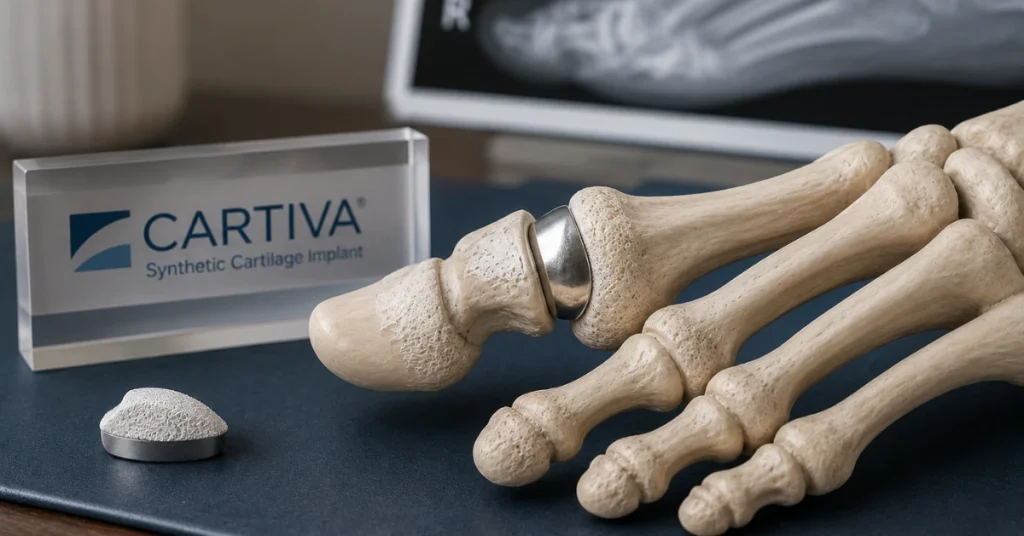
Reported failure rates for the Cartiva Synthetic Cartilage Implant vary sharply depending on which data source you look at. A peer-reviewed clinical follow-up study found a 6 percent revision rate over an average of 3.4 years, while a separate review of FDA adverse event reports found implant removal in more than 70 percent of the problem cases submitted to that database. The device itself was subject to a Class II recall from the FDA in late 2024, covering implants distributed from 2016 onward.
That gap between 6 percent and 70-plus percent is not a typo, and it is also not something most articles on this topic explain. The two numbers are measuring completely different groups of patients, and understanding that difference matters if you are trying to figure out whether your own experience fits a known pattern, or whether something else may be going on.
If you received a Cartiva implant and have dealt with ongoing pain, implant failure, or revision or fusion surgery, Baker Legal Team offers a free, no-cost case review to help you understand where you stand. There is no obligation, and the firm handles Cartiva cases on a contingency basis, meaning there is nothing owed unless a recovery is made. Here is what the data actually shows, and what it means for your situation.
What Is The Real Failure Rate For The Cartiva Toe Implant
There is no single agreed-upon failure rate for the Cartiva implant. The most rigorous available clinical data, a 2024 retrospective study of 67 implants published in the journal Cureus, found a 6.0 percent revision rate and 94 percent implant survivorship at an average follow-up of 3.4 years. That same study reported an overall complication rate of 19.4 percent, including cases of ongoing pain and stiffness that did not require further surgery.
A different, and much higher, figure comes from a 2024 study by Radcliffe and Roukis, published in Foot & Ankle Surgery: Techniques, Reports and Cases, which reviewed the FDA’s Manufacturer and User Facility Device Experience (MAUDE) database and examined 236 individual adverse event reports submitted over an 84-month period. That review found implant removal occurred in 73.7 percent of those specific reported cases.
So which number is right? Both are accurate for what they measure. They just are not measuring the same thing, which is the subject of the next section.
Marketing materials from the device’s original approval studies also cited favorable outcomes in a majority of patients at two years post-surgery. Real-world results reported since then have raised significant concerns about how well those early figures held up over the longer term.
Why Do Cartiva Failure Rate Numbers Vary So Much
Failure rate figures differ this much because the underlying populations being counted are not the same. The Cureus clinical study tracked a defined group of surgical patients over time, regardless of outcome, and calculated the revision rate against that entire group. The MAUDE database review only counted cases where a problem was serious enough that someone filed an adverse event report with the FDA in the first place.
In plain terms, one number describes what happened to everyone who got the implant. The other describes what happened among people who already had a problem worth reporting.
This distinction explains why legal and news sources sometimes cite failure rates as high as 79 percent, while clinical literature reports figures in the single digits for revision surgery specifically. Neither number is fabricated. But presenting an adverse-event-report statistic as if it applies to every Cartiva patient overstates the picture, and presenting only the clinical study’s low revision rate can understate how many patients experienced pain or complications that fell short of a full revision.
A few things worth keeping in mind when comparing these figures:
- Revision rate and complication rate are not the same measurement. The Cureus study’s 19.4 percent complication figure included patients who never had further surgery.
- Adverse event databases are self-reported and voluntary, which tends to concentrate on the more severe outcomes.
- Longer follow-up periods tend to reveal more complications, since some implant problems, like subsidence or bone changes, develop gradually rather than immediately after surgery.
Clinical study, Cureus 2024
67 implants, 3.4-year average follow-up
94% implant survivorship overall
FDA adverse event database
236 reported problem cases
Counts only already-reported cases
Same device, different denominator
The clinical study counts everyone treated.
MAUDE only counts already-reported problems.
What Did The FDA’s Cartiva Recall Say
The FDA lists a Class II recall for the Cartiva Synthetic Cartilage Implant, covering all lots distributed from July 2016 through October 2024. Stryker, which acquired the device through its purchase of Wright Medical, issued the recall notice on October 31, 2024, and the FDA posted the recall record in early December 2024.
The recall notice cited higher than expected rates of certain adverse outcomes, including revision surgery, removal surgery, and implant subsidence, where the implant or the surrounding bone settles or sinks over time. According to public FDA recall records, device design has been identified as a possible contributing factor, though the agency has noted this assessment may be updated as more information becomes available.
A Class II recall designation generally means the FDA has determined the device may cause temporary or reversible health consequences, or that the probability of serious harm is low, though it does not mean the risk is negligible. It is a distinct category from a full market withdrawal, though in this case use of the device has effectively stopped since the recall.
Baker Legal Team covered this recall in detail as it happened, including the corporate chain from Cartiva, Inc. to Wright Medical to Stryker, in a dedicated press release on the Cartiva recall.
What Are The Warning Signs Of Cartiva Implant Failure
Warning signs of Cartiva implant failure often develop gradually rather than appearing right after surgery. Some patients report problems within the first year, while others do not notice symptoms until years later.
Reported signs associated with implant failure include:
- New or worsening pain in the big toe joint, especially pain that returns after an initial period of relief
- Stiffness or a noticeable reduction in the toe’s range of motion
- A sensation that the implant has shifted, subsided, or is no longer sitting correctly
- Ongoing swelling around the joint that does not resolve with typical post-surgical recovery
- Difficulty bearing weight on the affected foot or a change in your walking pattern
- In rarer cases, signs of infection, such as redness, warmth, or drainage near the surgical site
If you are experiencing any of these symptoms, the right first step is a medical evaluation with your surgeon or a foot and ankle specialist. Legal questions can come after that, once you understand what is happening with the implant itself.
Where Does The Cartiva Litigation Stand Right Now
Federal Cartiva lawsuits have been consolidated into multidistrict litigation, MDL No. 3172, before Chief Judge Kristine G. Baker in the United States District Court for the Eastern District of Arkansas. The cases allege that the implant’s design led to failure rates higher than patients and physicians were told, and that the manufacturer did not adequately warn about risks including loosening, subsidence, bone erosion, and the need for revision surgery. It’s a pattern that shows up far beyond medical devices, including how defective product claims work across medical devices and watercraft, where the same design-defect standard led to a $39 million verdict against a personal watercraft maker.
For a closer look at how the case has progressed since the February 2026 transfer, Baker Legal Team’s Cartiva MDL update tracks the court’s case-management orders as they’re issued.
Every claimant still files an individual lawsuit either way. Whether that case belongs in the federal MDL or in state court is a separate question, one Baker Legal Team walks through in Cartiva MDL vs. state court, where to file your claim
These are allegations made by plaintiffs in ongoing litigation. The manufacturer has not been found liable in these matters, and causation between the implant’s design and any individual patient’s outcome has not been decided by a court. The MDL process exists specifically to coordinate discovery and pretrial proceedings across many similar cases before any bellwether trials take place, which have not yet occurred.
At this stage, the litigation is still developing, and case outcomes will depend on the specific facts of each patient’s implant, complications, and treatment history.
Does A High Failure Rate Mean You Have A Case
A reported complication or a recall does not automatically mean you have a legal case, but it is a reasonable starting point for finding out. Whether you have a viable claim depends on specifics: when you received your implant, what complications you experienced, whether you needed revision or fusion surgery, and how your treatment history lines up with the allegations being made in the ongoing litigation.
The most reliable way to find out where you stand is a free case review with an attorney experienced in defective medical device litigation. Baker Legal Team is currently reviewing Cartiva implant cases nationwide on a contingency fee basis, meaning there are no fees unless a recovery is made. You can reach the firm’s Cartiva intake line at 800-920-0002 for a free, no-obligation consultation.
Bottom Line
Cartiva failure rate statistics range widely because they measure different things. A peer-reviewed clinical study found roughly a 6 percent revision rate, while a review of FDA adverse event reports found removal in more than 70 percent of reported problem cases specifically. The FDA issued a Class II recall in late 2024, and federal lawsuits are now consolidated in MDL No. 3172 in Arkansas, alleging design defects and inadequate warnings that the manufacturer disputes. If you have experienced implant failure, ongoing pain, or revision surgery after a Cartiva implant, a free case review can help clarify whether your situation fits the pattern behind the current litigation.
Frequently Asked Questions
What is the actual failure rate of the Cartiva implant?
The actual failure rate of the Cartiva implant depends on the data source. A 2024 clinical study found a 6 percent revision rate over roughly three years, while an FDA adverse event database review found implant removal in more than 70 percent of specifically reported problem cases, a much narrower and more severe subset of patients.
Has the Cartiva toe implant been recalled?
Yes, the Cartiva toe implant has been recalled. The FDA lists a Class II recall covering all lots distributed from July 2016 through October 2024, issued after post-market data showed higher than expected rates of revision surgery, removal, and implant subsidence.
How long after surgery do Cartiva implants typically fail?
There is no single timeline for when Cartiva implants typically fail. Some patients in clinical follow-up experienced complications within the first two years, while others reported problems developing several years after implantation, which is one reason long-term monitoring matters.
What should I do if I think my Cartiva implant has failed?
If you think your Cartiva implant has failed, the first step should be a medical evaluation with your surgeon or a foot and ankle specialist to confirm what is happening with the device. After that, you can look into whether your situation qualifies for a legal case review.
Is there a lawsuit against the maker of the Cartiva implant?
Yes, there is an active lawsuit against the maker of the Cartiva implant. Federal cases have been consolidated into MDL No. 3172 in the Eastern District of Arkansas, where plaintiffs allege design defects and failure to warn, claims the manufacturer disputes and that have not been decided by a court.
Do I need to have had revision surgery to file a Cartiva claim?
You do not necessarily need to have had revision surgery to explore a Cartiva claim, though it is a common factor in many cases. Ongoing pain, subsidence, or other documented complications may also be relevant, and a free case review is the most reliable way to find out.
For a full breakdown of what does and does not qualify, see our guide to Cartiva lawsuit eligibility.
Does a Cartiva lawsuit cost anything to start?
No, starting a Cartiva lawsuit review does not cost anything upfront with a firm working on contingency. Baker Legal Team reviews Cartiva cases nationwide at no cost, and fees only apply if a recovery is obtained.