


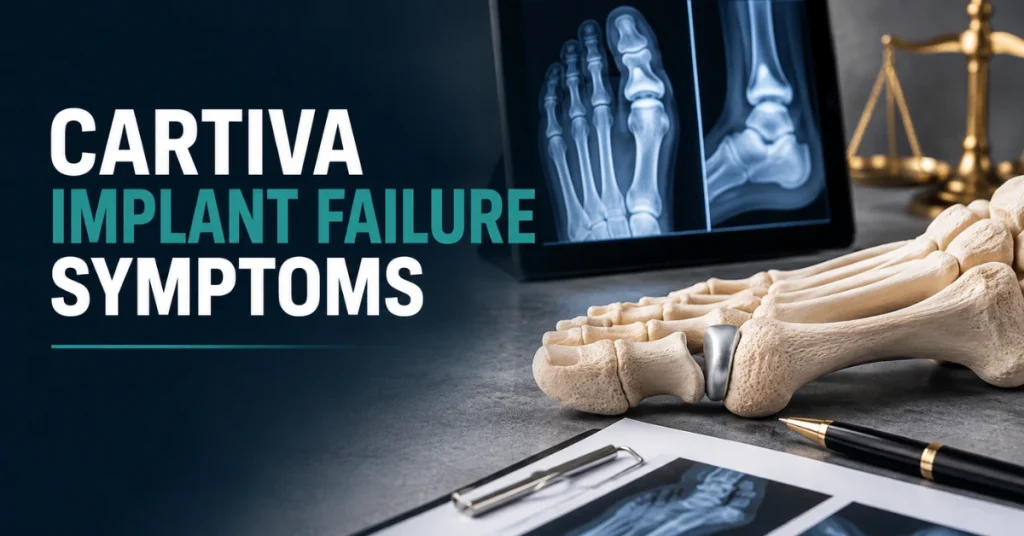
The most common signs of Cartiva implant failure are pain that returns after an initial period of relief, stiffness or lost motion in the big toe joint, and a sense that the implant has shifted or settled into the surrounding bone. When those symptoms don’t respond to conservative treatment, the usual next step is revision surgery or, in more advanced cases, fusion surgery, which permanently joins the big toe joint.
Not every failed Cartiva case ends in fusion, and whether it does often depends on how long the problem went unaddressed, not just on the implant itself, which is exactly the kind of detail that shapes how strong a legal claim ends up being. Most people also don’t realize that fusion surgery becomes evidence in its own right, documenting the extent of the damage, rather than a complication to downplay when talking to a lawyer.
If you’ve had, or are now facing, fusion surgery after a Cartiva implant, that is exactly the kind of documented outcome Baker Legal Team is reviewing right now. The firm offers a free case review, works on contingency, and there are no fees unless a recovery is made. Here’s what the warning signs look like, how treatment typically escalates, and why fusion changes the picture.
What Are the Signs of Cartiva Implant Failure?
The signs of Cartiva implant failure typically include returning pain, stiffness, or a sense that the implant has shifted or settled into the surrounding bone. These symptoms can appear within the first year or develop gradually over several years.
Reported signs associated with implant failure include:
New or worsening pain in the big toe joint, especially pain that returns after an initial period of relief
Stiffness or a noticeable reduction in the toe’s range of motion
A sensation that the implant has shifted, subsided, or is no longer sitting correctly
Ongoing swelling around the joint that does not resolve with typical post-surgical recovery
Difficulty bearing weight on the affected foot or a change in your walking pattern
In rarer cases, signs of infection, such as redness, warmth, or drainage near the surgical site
If you are experiencing any of these symptoms, the right first step is a medical evaluation with your surgeon or a foot and ankle specialist. Legal questions can come after that, once you understand what is happening with the implant itself.
For how often these problems occur, and why published failure rates vary so widely, see our breakdown of Cartiva implant failure rates.
What Happens After a Cartiva Implant Fails?
Once failure is suspected, the usual path starts with imaging and a clinical evaluation to see how the implant and surrounding bone look. From there, treatment generally escalates in stages rather than jumping straight to the most invasive option.
Common escalation points include:
- Conservative management first (rest, anti-inflammatory treatment, activity modification)
- Revision surgery, replacing or removing the failed implant, if conservative treatment doesn’t resolve the problem
- Fusion surgery, permanently joining the joint, if revision isn’t a viable option due to bone loss or joint damage
Not everyone moves through every stage. Some patients go straight from a failed implant to fusion if the joint damage is already severe by the time the failure is caught, a pattern reflected in current Cartiva litigation.
Why Does Cartiva Failure Sometimes Require Fusion Surgery Instead of Revision?
Fusion surgery becomes necessary instead of revision when there isn’t enough healthy bone or cartilage left at the joint to support another implant. In that situation, joining the bones permanently is often the only remaining option to restore stability and reduce pain.
This is a meaningfully different outcome than revision. Revision surgery generally aims to replace the failed component and preserve the joint’s motion. Fusion sacrifices that motion in exchange for a stable, pain-free joint.
A few factors tend to influence whether a patient ends up needing fusion rather than revision:
- How long the implant failure went undiagnosed or untreated
- How much bone erosion or subsidence occurred before treatment
- Whether earlier revision attempts, if any, were unsuccessful
- The overall condition of the joint at the time of evaluation
This is one of the reasons timing matters. The longer a failing implant goes unaddressed, the more likely the outcome shifts from a revision to a fusion.
Does Needing Fusion Surgery Strengthen a Cartiva Legal Claim?
Needing fusion surgery does not automatically make a legal claim stronger or weaker on its own, but it is one of the more serious documented outcomes that current litigation is built around. Fusion represents a permanent loss of joint motion, which is a meaningfully different level of harm than a revision that restores function.
Cartiva implants distributed from July 2016 through October 2024 are subject to a Class II FDA recall, and federal cases alleging design and warning defects are consolidated in MDL No. 3172. The claims in those cases are allegations the manufacturer disputes, and causation has not been decided in court. The data behind the recall is covered in our Cartiva implant failure rates analysis, and the case’s progress is tracked in our Cartiva lawsuit update.
It’s a common misconception that having surgery somehow works against a claim, as if treating the problem undermines the case. In reality, the opposite is usually true. Surgical records, especially records showing why revision wasn’t a viable option and fusion was required, are some of the clearest documentation available of how serious the implant failure actually was.
What tends to matter most for a claim isn’t the surgery itself, but what the surgical and medical records show:
- The condition of the joint and bone at the time of surgery
- The surgeon’s documented reasoning for choosing fusion over revision
- The timeline between implant, symptoms, diagnosis, and surgery
- Any complications or ongoing limitations following fusion
If you’re facing this decision, the right first step is still a conversation with your treating surgeon about what’s medically appropriate for you. The legal side of things can be reviewed separately, once your medical situation is clear.
What Should You Document Before and After Fusion Surgery?
Documentation matters most when it captures the full timeline from implant to failure to fusion, not just the surgery itself. Gaps in that timeline can make it harder to connect a patient’s specific outcome to the broader pattern being alleged in litigation.
Helpful records to gather include:
- Original implant records, including the surgery date, the specific device used, and any lot or serial number available
- Symptom timeline, including when pain, stiffness, or other issues first appeared and how they progressed
- Imaging and diagnostic records showing the implant’s condition before revision or fusion was recommended
- Surgical notes explaining why fusion, rather than revision, was the chosen path
- Post-surgical records documenting recovery, any complications, and current limitations
If you’re not sure whether you have all of this on hand, a medical records request through your surgeon’s office or hospital is usually the fastest way to fill in gaps before a legal case review.
What Compensation Might Be Available for Fusion Surgery Costs?
Compensation in a Cartiva claim involving fusion surgery can potentially cover the cost of the fusion procedure itself, along with related medical expenses, lost wages, and the impact of permanently reduced joint mobility. The exact value depends on the specific facts of each case, and our guide to what a Cartiva claim is worth explains which of those facts move it most.
Fusion carries a different practical impact than revision. Losing motion in the big toe joint can affect walking, balance, and the ability to return to certain physical activities or occupations, all of which can factor into how a case is evaluated.
Past outcomes in other cases don’t guarantee any particular result. Every claim is evaluated on its own medical records, timeline, and documented history.
Bottom Line
When a Cartiva implant fails badly enough, fusion surgery can become the only remaining option, and that outcome carries more legal weight than a straightforward revision. What matters most for a potential claim isn’t the surgery itself, but the documented timeline connecting the original implant, the failure, and the decision to fuse the joint.
If you’ve had or are facing fusion surgery after a Cartiva implant, a free Cartiva toe implant lawsuit review can help clarify whether your situation fits the pattern behind the current litigation.
Frequently Asked Questions
What happens if a Cartiva implant fails?
If a Cartiva implant fails, treatment usually starts with conservative management and can escalate to revision surgery or, in more severe cases, fusion surgery, depending on how much bone and joint damage has occurred.
Is fusion surgery worse than revision surgery for a failed Cartiva implant?
Fusion surgery generally represents a more severe outcome than revision surgery, since fusion permanently joins the joint and eliminates its motion, while revision aims to restore function by replacing the failed implant.
Does having fusion surgery hurt my chances in a Cartiva lawsuit?
No, having fusion surgery does not hurt your chances in a Cartiva lawsuit. Surgical records documenting why fusion was necessary are typically viewed as evidence of the severity of the implant failure, not as a factor that weakens a claim.
How do I know if my Cartiva case involves the manufacturer’s alleged knowledge of long-term risks?
You may not know on your own, since this involves allegations made in ongoing litigation about what the manufacturer knew, and a case review is generally the most reliable way to find out whether your situation fits that pattern.
What records do I need before pursuing a Cartiva fusion surgery claim?
You’ll generally need your original implant records, a timeline of your symptoms, imaging showing the implant’s condition, surgical notes explaining the choice of fusion over revision, and post-surgical recovery records.
Can I file a claim if I haven’t had fusion surgery yet but my doctor says I need it?
Yes, you can generally explore a claim even if fusion surgery hasn’t happened yet, since a documented recommendation for fusion, along with your prior implant and treatment history, may still be relevant to a case review.
Does a Cartiva fusion surgery claim cost anything to start?
No, starting a Cartiva claim involving fusion surgery does not cost anything upfront with a firm working on contingency, since fees only apply if a recovery is obtained.