


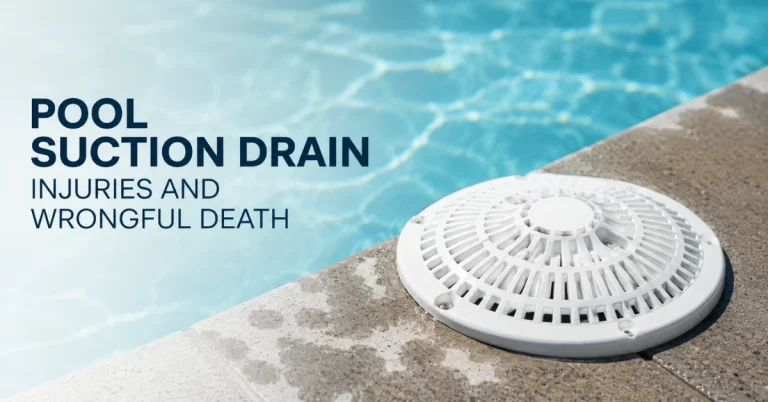
The force of a pool circulation pump is measured in pounds per square inch. Most hotel and public pool pumps generate between 100 and 300 pounds of suction at the drain opening. A pool suction drain injury – also called suction entrapment – happens when that force is applied directly to a human body. An adult cannot break free once entrapped. A child has no chance.
I’ve spent 30 years handling drowning cases in South Florida. Pool drain entrapment is one of the most misunderstood hazards in aquatic injury litigation. Families assume the accident was unforeseeable. Insurance companies encourage that assumption. But federal law has required compliant drain covers on every public pool and spa in the United States since December 2008. When a pool operator runs an uncovered drain, a cracked cover, or a single-drain system with no secondary safety device, they are operating in violation of a federal statute that exists for one specific purpose: to prevent exactly the kind of injury that just happened to your child.
That violation matters enormously in a civil case. This page explains what pool suction drain injuries are, what the law requires, who can be held liable, and why these cases sit at the intersection of premises liability and product defect law – a combination that requires specific litigation experience to handle correctly.
Two Children Who Changed the Law
Before getting into the legal framework, I want to tell you about the two children whose deaths and injuries produced the statute that governs every public pool in America today. These aren’t abstractions – they’re the reason the law exists, and understanding them tells you exactly what pool operators were required to do after 2008 and exactly why a violation of that requirement is indefensible.
In 1993, a five-year-old girl named Valerie Lakey was playing in a wading pool at a recreation club in Cary, North Carolina. She became entrapped on the pool’s main drain. Her father and three other adults could not pull her free. Turning off the pump did not release the pressure fast enough. By the time she was freed, her small and large intestines had been drawn out of her body through evisceration. Valerie survived – but at nine years old, she required intravenous feeding for at least 11 hours every day. A North Carolina jury awarded her family $30.9 million, with $25 million from drain manufacturer Sta-Rite Industries and $5.9 million from the county and the recreation club. The drain cover had no warning label indicating what would happen if a child sat directly on it. Sta-Rite settled rather than face punitive damages. No federal law existed yet to require anything different.
Nearly a decade later, in 2002, a seven-year-old named Virginia Graeme Baker was trapped underwater by the suction of a hot tub drain at a private home. Bystanders could not pull her free. She drowned. Virginia’s mother, Nancy Baker, is the daughter of former U.S. Secretary of State James Baker. She spent the next five years advocating for federal pool drain safety legislation. In 2007, Congress passed the Virginia Graeme Baker Pool and Spa Safety Act. It took effect December 19, 2008. That is the statute that governs your case.
I tell you this because the history matters. These weren’t freak accidents. They were predictable outcomes of drain designs that the industry knew were dangerous and chose not to fix. When a pool operator violates the VGB Act today, they are doing the same thing Sta-Rite did in 1993 – maintaining a hazard they were legally required to correct, for a child who had no way of knowing the danger.
What Pool Suction Drain Injury Is and Why It Kills
Pool suction drain injury occurs when a swimmer’s body, hair, clothing, or limbs are held against or pulled into a pool drain by the force of the circulation pump. The pump that filters and circulates pool water runs continuously. The drain at the bottom of the pool is where water exits to be filtered. When that drain lacks a compliant cover – or when the cover is cracked, missing, or non-compliant – the suction operates directly against whatever comes in contact with it.
The CPSC recognizes five types of suction entrapment, each capable of causing death or catastrophic injury:
- Body entrapment – A portion of the torso, back, or buttocks completely covers the drain opening, creating a vacuum seal. The suction holds the person pinned underwater. Body entrapment accounts for roughly 35 percent of documented entrapment incidents. The person appears to be floating calmly from above. They cannot surface. They drown.
- Hair entrapment – Hair is pulled into the drain and wraps around internal components. The person becomes anchored to the bottom of the pool. Between 1990 and 2004, the CPSC documented 43 hair entrapment incidents in pools and spas, 12 of which were fatal. Hair entrapment doesn’t require the drain to be uncovered – it can occur through the gaps in a non-compliant grate.
- Limb entrapment – An arm, leg, hand, or foot is pulled into an open drain pipe, trapping the limb. This accounts for about 31 percent of documented cases. A toddler reaches for something near the drain, or places a foot over the outlet while sitting on the pool step. The limb enters. The pump pressure holds it there.
- Mechanical entrapment – A swimsuit drawstring, jewelry, or loose clothing gets caught in the grate and anchors the person to the drain. The person is not held by suction but cannot detach from the drain cover. Children’s swimwear with drawstrings is a known risk factor – which is why so many children’s swimsuits now come with elastic waistbands rather than strings.
- Evisceration – The rarest and most severe outcome. A child sits directly on an uncovered or missing drain. The suction is applied directly to the rectum, drawing out intestines through the body. This is what happened to Valerie Lakey. It occurs in a fraction of a second. It requires the drain to be operating with no cover – a condition that should never exist in any legally operated public pool.
In the absence of a compliant drain cover and functional secondary safety system, any child in a public pool is one dive, one stumble, one moment of underwater exploration away from any of these five outcomes. That is exactly why Congress passed the Virginia Graeme Baker Act.
The Virginia Graeme Baker Act: What It Requires and What It Means in Court
The VGB Act was enacted in 2007 and took effect December 19, 2008. It is administered by the Consumer Product Safety Commission and applies to any public pool or spa – meaning commercial, hotel, resort, HOA, apartment complex, water park, and municipal facility. Residential backyard pools are governed by a separate Florida statute, F.S. 515.27. The VGB Act requirements for public pools:
- Drain covers must comply with the ANSI/APSP-16 standard – the successor to the original ASME/ANSI A112.19.8-2007 standard incorporated into the Act. These covers are specifically engineered so they cannot create suction entrapment. The geometry of the grate, the flow rate, and the dimensions all meet tested anti-entrapment thresholds. Covers must be marked with their service life. A cracked, damaged, or expired cover is a violation regardless of when it was originally installed.
- Single-drain pools and spas with a blockable drain must have a secondary anti-entrapment system. Options include: a Safety Vacuum Release System (SVRS) that detects the pressure spike of an entrapment event and automatically shuts off the pump; a gravity drainage system; a suction-limiting vent system; or drain disablement. This is where most hotel and commercial pool operators are caught – they replaced the drain cover after 2008 but never installed the required secondary system. The cover requirement gets attention. The secondary system requirement is what operators miss.
- Compliance is continuous, not one-time. A cover that met the standard when installed but has since cracked, aged past its service life, or been replaced with a non-compliant cover is a violation at the moment of injury. The CPSC has issued multiple safety warnings and recalls for non-compliant drain covers sold on Amazon, including a December 2025 warning, reflecting an ongoing supply chain problem that pool operators must actively watch. Buying a replacement cover on Amazon without verifying ANSI/APSP-16 compliance is a violation waiting to happen.
There’s a pump-to-cover mismatch problem I want to address specifically, because it’s a product liability theory that operates independently of the premises liability theory. A drain cover can be technically compliant with the ANSI/APSP-16 standard as rated – but if the pool’s circulation pump generates flow that exceeds the cover’s rated capacity, the cover fails. The suction bleeds through. The cover didn’t fail because of age or damage; it failed because it was matched to the wrong pump. This creates a product defect claim against the manufacturer or the contractor who specified the system, running alongside and separate from the property owner’s liability. It’s a theory that a general personal injury attorney won’t identify. It’s also one of the most valuable theories in a serious entrapment case.
The significance of a VGB Act violation in Florida civil litigation goes beyond evidence of negligence. Florida courts apply the negligence per se doctrine: when a property owner violates a safety statute designed to protect a class of people – here, swimmers and specifically children – from the exact type of harm that occurred, that violation is itself evidence of negligence. The injured party doesn’t have to argue the pool operator should have known better. The federal statute established the standard. The violation establishes the breach. The injury establishes the damages. That is the foundation of the case.
Who Can Be Held Liable
One of the features of pool drain entrapment cases that distinguishes them from other drowning cases is the potential for multiple liable parties – often pursuing two separate legal theories against different defendants simultaneously.
The property owner or operator carries primary premises liability exposure. Hotels, resorts, apartment complexes, HOAs, and commercial pool operators have a non-delegable duty to maintain their pools in compliance with applicable safety laws, including the VGB Act. This duty doesn’t transfer to a management company or a pool service contractor – it stays with the entity that owns or controls the facility. When a hotel pool runs a non-compliant single-drain system without a secondary safety device, or when a cracked drain cover goes uninspected for months, that is a failure the property owner owns regardless of who they hired to inspect it.
HOA pools deserve specific attention. Homeowners associations routinely operate pools with smaller maintenance budgets and less consistent oversight than hotel properties. HOA boards often assume they’re protected by the same homeowner insurance policies that cover the association’s other liabilities. They’re not always correct. An HOA that operates a non-compliant pool is exposed to the same VGB Act liability as any commercial operator – and the association’s duty to its residents and their guests is well-established in Florida premises liability law.
But property liability is often not the only theory. The drain cover itself may be defective – designed, manufactured, or labeled in a way that fails to meet the standard even when the cover appears to be in place. This opens product liability exposure against the drain cover manufacturer. A cover can be facially compliant yet fail to perform under actual pump flow conditions. A cover can be marked with a service life date that turns out to be inaccurate for the actual conditions of use. The pump-to-cover mismatch I described above is this theory in its clearest form. I realize that’s more complicated than “the drain cover was cracked” – but in many of the most serious entrapment cases, the more complicated theory is also the more valuable one. Any of these creates a product defect claim that runs parallel to – and independent of – the premises liability theory against the property owner.
Additional defendants can include:
- Pool service and maintenance companies that inspected or serviced the pool and missed or failed to report a non-compliant drain cover or damaged secondary safety system. The maintenance company’s inspection records may become as valuable as the property owner’s – both as evidence of what they found, and as evidence of what they failed to look for.
- Pool builders and contractors that installed the original drain system incorrectly or used non-compliant components in construction. If the original installation put a pump into service that exceeded the drain cover’s rated flow, the contractor created the defect on day one.
- Property management companies that operated the pool day-to-day and are responsible for inspection and maintenance schedules. A management company that collected monthly fees and failed to conduct required inspections is not insulated from liability by pointing at the property owner.
Identifying all liable parties from the start – and preserving evidence from all of them before it disappears – is one of the most consequential decisions in pool drain litigation. The pump system, the drain cover, the maintenance records, the inspection logs, and the pool’s permit and compliance history are all evidence that exists today and may not exist after a pool operator replaces the cover or repairs the system. That evidence disappears fast, and in my experience, it sometimes disappears suspiciously fast once a property owner realizes there’s going to be a claim.
How Insurance Defense Works in These Cases
I want to be direct about what happens on the other side of these cases, because knowing it changes how families should respond in the immediate aftermath.
Within hours of a serious pool injury or drowning, the property owner’s liability insurer has usually been notified. An insurance adjuster – or in serious cases, a lawyer retained by the insurer – may be on the scene before the family has left the hospital. Their job is not to help your family. Their job is to assess the claim, document the scene in a way that protects the insurer’s interests, and begin establishing the narrative of what happened.
That narrative often goes like this: the victim was unsupervised; the drain cover was in place and appeared to be in good condition; no prior incidents had been reported; the pool was in compliance. These talking points are assembled quickly. An adjuster walking around a pool 48 hours after an incident can photograph a replacement cover that looks pristine – because the operator replaced the damaged one after the injury. That’s spoliation of evidence, and it happens. I have seen it.
An attorney who gets involved immediately can counter this. A preservation letter sent to the property owner creates a legal obligation to maintain the evidence in its current state. Failure to do so after receiving a preservation letter converts an operator’s cover-up into an evidentiary weapon for your case. Courts take spoliation seriously. But the letter has to go out before the evidence is gone.
Why This Case Requires Both Premises Liability and Product Defect Experience
A general personal injury attorney can handle a slip-and-fall at a hotel pool. Pool drain entrapment or suction-related drowning is a different kind of case – and I say that not to be dismissive, but because the distinction has real consequences for the family.
The premises liability side requires specific knowledge of the VGB Act – not just that pool drains need covers, but the distinction between blockable and unblockable drains, the specific secondary system options for single-drain pools, the service life marking requirements, and how Florida courts have applied the negligence per se doctrine to federal safety statute violations in pool injury cases. An attorney who doesn’t know the difference between an SVRS and a suction-limiting vent system cannot identify whether the pool’s secondary system was compliant at the time of the incident. That’s a liability theory left on the table.
The product liability side requires the ability to identify whether the drain cover in place at the time of the incident was compliant with ANSI/APSP-16, whether it had been recalled or flagged by the CPSC, and whether the pump system was matched appropriately to the cover’s rated flow. A mismatch can create entrapment suction even through a technically compliant cover. Identifying that mismatch requires an engineering analysis that a premises-only attorney won’t know to commission.
Baker Legal Team’s combination of 30 years of pool drowning litigation and board-certified civil trial experience in product defect cases covers both. The $39 million verdict in Archer and Perez v. Yamaha was a product defect case against a major manufacturer that knew about a design flaw and didn’t correct it. The legal theory that won that case – that a corporation’s knowledge of a defect combined with its failure to correct it creates the highest level of product liability exposure – applies directly to drain cover manufacturers and pool operators who were on notice about entrapment risks and chose not to act. The legal theory is the same. The courtroom experience to execute it is what matters.
Verdicts in pool drowning and near-drowning cases Robert has handled include cases against hotel properties in Florida where the investigation revealed inadequate drain compliance. The Days Inn case documents Robert’s record in holding hotel property owners accountable for pool safety failures – knowing how hotel insurance defense works, what discovery to pursue, and how to present a technically complex drain compliance case to a jury. That is what this case type requires.
Damages in Pool Drain Injury Cases
I want to be specific about what recovery looks like in these cases, because the families I represent often underestimate what they’re entitled to – particularly in near-drowning cases involving anoxic brain injury.
In a wrongful death case, recoverable damages under Florida law include medical expenses prior to death, funeral and burial costs, loss of support and services to survivors, loss of parental companionship and guidance, and mental pain and suffering of surviving family members. Florida’s Wrongful Death Act (F.S. 768.16) governs who can recover and in what capacity – and the specifics matter, particularly in cases involving minor children or unmarried decedents.
In a near-drowning case involving anoxic brain injury, the damages can be larger than a wrongful death claim. Oxygen deprivation during an entrapment event – even a relatively brief one – can produce permanent cognitive damage, motor impairment, and seizure disorders. The damages in an anoxic brain injury case include:
- Past and future medical expenses, often running into the millions for catastrophic impairment
- Lifetime nursing and attendant care costs, typically documented by a certified life care planner whose projections become a central exhibit at trial
- Lost earning capacity across a lifetime – for a child, this requires economic expert testimony projecting what that child would have earned absent the injury
- Pain and suffering for the duration of the victim’s life
- In cases involving a property owner’s knowledge of prior incidents and deliberate non-compliance, punitive damages
The Valerie Lakey verdict – $30.9 million in 1993 – was for a child who survived but with permanent, catastrophic injuries requiring lifelong care. In today’s dollars and with today’s medical cost trajectory, that number would be substantially higher. That’s higher than most families expect when they first call me. These cases produce large verdicts because the harm is large, documented, and permanent.
Florida’s Statute of Limitations for Pool Drain Injuries
Florida’s 2023 tort reform amendments cut the statute of limitations for negligence and wrongful death claims to two years from the date of injury or death (F.S. 95.11(4)(a)). This is two years – not four years as previously applied, and not variable based on where the victim’s family lives. Out-of-state families frequently lose these cases because they assume their home state’s longer limitations period applies to a Florida pool accident. It does not. Florida law governs the Florida incident.
For minors who were injured but survived, the limitations period may be tolled until they reach majority in some circumstances – but this does not apply to wrongful death claims, and Florida courts interpret tolling exceptions narrowly. The assumption that more time is available is dangerous and frequently incorrect. I have had families contact me after the two-year window has closed, certain that the tolling exception protected them. It didn’t.
The two-year clock starts running on the date of the incident, not the date of diagnosis of a delayed injury, and not the date a family learns the pool was non-compliant. Evidence preservation operates on an entirely separate timeline: hotel pool maintenance records, surveillance footage, and drain inspection logs are routinely destroyed or overwritten within 30 to 90 days in the ordinary course of business. An attorney retained in the week after an incident can preserve that evidence. An attorney retained a year later often cannot – and by then the drain cover has been replaced, the pump records have been discarded, and the pool has passed its next inspection with a clean bill of health.
What to Do After a Pool Drain Injury or Drowning
If a drain entrapment injury or drowning has just occurred at a hotel, resort, HOA pool, or any other public or commercial facility, the steps that happen in the first 48 to 72 hours determine what evidence is available for the case that follows.
- Do not allow the pool to be reopened or the drain cover replaced. Contact the property manager or owner in writing immediately – a text or email is sufficient to create a record – stating that the equipment and area must be preserved as evidence. If the pool is already back in operation, a preservation letter from an attorney carries legal weight that a family’s request does not.
- Photograph everything before anything is disturbed. The drain cover, the pump system, warning signs, depth markers, the surrounding area. If the drain cover is cracked, missing, visibly aged, or has any visible damage, document it from multiple angles. Get time-stamped photos.
- Request the pool’s compliance and inspection records. When was the drain cover last replaced? What secondary anti-entrapment system does the pool use? When was the last inspection? You may not receive these voluntarily – but the request creates a record of the request itself, and a refusal creates its own evidentiary significance.
- Do not give a recorded statement to the property owner’s insurance adjuster before speaking with an attorney. The adjuster’s job is to assess the claim for the insurer. Anything you say in a recorded statement will be used to limit what the insurer pays. You are not legally required to provide a statement to the opposing party’s insurance company.
- Retain legal counsel immediately. Evidence preservation in these cases is not something that can wait weeks. The property owner’s insurer may already have an adjuster or attorney working the file. The same urgency applies to your investigation.
If your child was injured or killed at a pool in South Florida – at a hotel, an HOA facility, a water park, or any commercial property – contact Baker Legal Team for a free consultation. Robert personally handles accepted cases. There are no fees and no costs unless he wins. The consultation is private and without obligation.
For context on Robert’s record in pool drowning and wrongful death cases, visit the swimming pool accidents practice page and the drowning accidents page. The Days Inn case results documents what a hotel pool liability case looks like when it’s fully litigated by an attorney who refuses to settle for less than the case is worth. Attorneys with pool drain entrapment matters outside their experience are welcome to inquire about our co-counsel program.
Frequently Asked Questions
What is a pool suction drain injury?
Pool suction drain injury – also called suction entrapment – occurs when a swimmer’s body, hair, clothing, or limbs are held against or drawn toward a pool drain by the force of the circulation pump. The CPSC recognizes five types: body entrapment, hair entrapment, limb entrapment, mechanical entrapment, and evisceration. In all five, the person is unable to free themselves without external intervention. Body entrapment and hair entrapment are the most common causes of drowning death in documented entrapment incidents.
What does the Virginia Graeme Baker Act require pool owners to do?
The VGB Act, which took effect December 19, 2008 and is enforced by the CPSC, requires all public pools and spas to install drain covers that comply with the ANSI/APSP-16 anti-entrapment standard. Pools with a single blockable main drain must also install a secondary anti-entrapment system – typically a Safety Vacuum Release System (SVRS) that automatically shuts off the pump when entrapment pressure is detected, or another approved device. Cracked, damaged, or expired covers are violations regardless of when they were installed. Residential pools in Florida are governed separately by F.S. 515.27.
Who can be sued for a pool drain injury or drowning?
Multiple parties are potentially liable: the property owner or operator (hotel, HOA, apartment complex, resort) under the VGB Act and Florida premises liability law; the drain cover manufacturer if the cover was defective, non-compliant, or incorrectly rated for the pump in use; the pool service or maintenance company that inspected the pool and missed non-compliance; and the pool contractor if the original installation created the mismatch between pump output and drain cover capacity. Identifying all liable parties and preserving evidence from each of them at the outset is one of the most consequential decisions in this litigation.
How does a VGB Act violation affect a Florida civil lawsuit?
Florida applies the negligence per se doctrine to statutory violations. When a pool operator violates the VGB Act – a federal safety statute specifically designed to prevent suction entrapment injuries and deaths – that violation is evidence of negligence in the civil case. The injured party doesn’t have to separately argue that the operator was careless. The statute established the required standard of care. The violation establishes the breach. The connection to the injury establishes causation. A VGB Act violation significantly strengthens the plaintiff’s case on liability, and in Florida, shifts the conversation from whether the operator was negligent to how much the operator is going to pay.
What is the statute of limitations for a pool drowning case in Florida?
Under F.S. 95.11(4)(a) as amended in 2023, Florida’s statute of limitations for negligence and wrongful death claims is two years from the date of injury or death. This applies to out-of-state families – Florida law governs the Florida incident regardless of where the victim’s family lives. Tolling for minors may apply in some injury cases but does not apply to wrongful death claims. Florida courts interpret tolling exceptions narrowly. Do not assume more time is available without consulting a Florida attorney promptly after the incident.
Can I sue if my child survived a drain entrapment but suffered brain damage?
Yes – and in some respects, near-drowning cases involving anoxic brain injury produce higher verdicts than wrongful death cases, because the damages extend across a lifetime of care. Oxygen deprivation during entrapment can produce permanent cognitive damage, motor impairment, and seizure disorders. The damages in these cases require medical experts, a certified life care planner to project lifetime care costs, and economic experts to calculate lost earning capacity across a lifetime. These are technically complex damages claims that need to be built from the start of the case, not assembled at the last minute before trial.
Does it matter if the incident happened at an HOA pool rather than a hotel?
The VGB Act applies to HOA pools exactly as it applies to hotel pools. Any publicly accessible pool or spa at a commercial or residential community facility is covered. HOA boards sometimes believe they are insulated from liability by their homeowners insurance or by the fact that the pool was built before 2008. Neither is correct. The compliance obligation has been continuous since December 2008. An HOA operating a pool with a non-compliant drain cover or without a required secondary anti-entrapment system is in violation of federal law, and the negligence per se analysis applies the same as it does to a hotel.
What if the pool drain cover appeared to be in place at the time of the incident?
The presence of a drain cover does not mean the pool was in compliance. A cover can be in place and still violate the VGB Act if it is cracked or damaged, has expired past its service life date, was replaced with a non-compliant cover from a low-cost supplier, or is the correct cover for a different pump than the one running the pool. This last scenario – the pump-to-cover mismatch – is a product defect theory that runs independently of the premises liability theory. The cover can appear intact, meet no obvious CPSC recall list, and still fail to prevent entrapment because the pump generates more flow than the cover was rated for. This is why the engineering analysis of the pump system is as important as the inspection of the drain cover itself.