


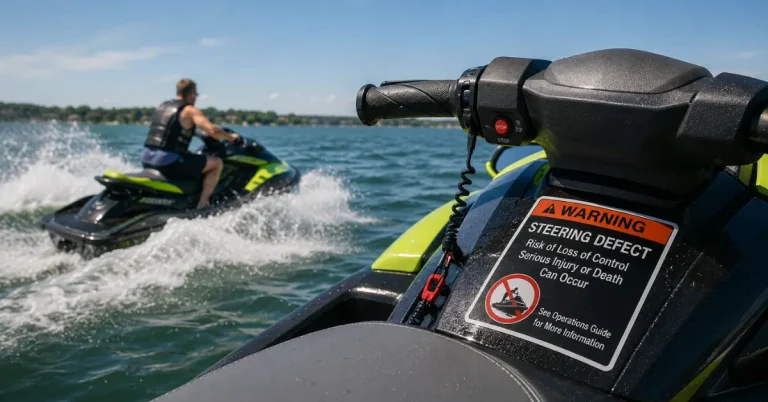
$39 million. That’s what a Palm Beach County jury awarded against Yamaha for a defect the company spent years denying existed. I was lead trial attorney on that case, Archer and Perez v. Yamaha, and it’s still the largest personal watercraft verdict in U.S. history. If you’re researching a jet ski accident attorney because your accident felt wrong somehow, like the machine refused to respond exactly when you needed it most, keep reading. This is the defect I spent years proving in court, and it may be the reason you’re hurt.
My name is Robert Baker. I’ve tried more than fifty jury trials in thirty years of practice, and the Yamaha case still sits apart from the rest. Not because of the number, honestly, the number gets the headlines, but the verdict itself barely tells the story. What matters is what happened to every jet ski built after that trial ended.
What Off-Throttle Steering Actually Does to a Jet Ski
A jet ski doesn’t steer the way a boat does. There’s no rudder cutting through the water independent of the engine. Steering on a personal watercraft comes entirely from thrust, the same jet of water pushed out the back that propels the machine forward gets redirected by the nozzle to turn it. Take away the throttle, and you take away the thrust. Take away the thrust, and the handlebars become almost decorative. The machine goes straight no matter which way you turn them.
Here’s the danger built into that design. Riders panic the same way drivers do. When something appears in front of you, a dock, another rider, a swimmer, the instinct is to let go of the throttle and steer away. On a car, that works fine. On a jet ski built without off-throttle steering protection, letting go of the throttle is close to the worst thing you can do in that moment. You lose your ability to turn at the exact second you need it most.
As a Florida jet ski accident attorney, I’ve seen this pattern repeat case after case. Fort Lauderdale, Broward County, and Palm Beach waters see a disproportionate share of these accidents because the recreational rental and tourist traffic here runs heavier than almost anywhere else in the country.
How Yamaha Knew About the Danger and Said Nothing
This wasn’t a defect Yamaha stumbled into. Internal engineering records and prior litigation showed the company understood the off-throttle steering problem years before my clients were hurt. Competing manufacturers had already explored steering-override concepts. Patent filings existed for systems that could maintain partial thrust after a rider released the throttle. The technology to reduce this exact danger wasn’t science fiction. It existed. It just wasn’t in the machines being sold to families and tourists.
What I proved at trial wasn’t that Yamaha built a jet ski that could be dangerous under certain conditions, every powered vehicle carries some risk. What I proved was that Yamaha knew the specific danger, understood how predictably riders would panic and release the throttle, and chose not to warn riders adequately or fix the design before more people got hurt.
What Archer and Perez v. Yamaha Proved at Trial
My clients were riding a Yamaha WaveRunner when the defect put them directly into another vessel. The injuries were catastrophic, the kind that don’t heal on a normal timeline and change what a person’s life looks like going forward. Expert testing conducted for the case documented the exact failure point, footage showing a rider losing all steering authority the instant the throttle was released, with the handlebars turned fully and the machine continuing straight ahead regardless.
At trial, my team walked the jury through that mechanical failure using the same engineering evidence Yamaha had access to internally. We showed the jury what the company knew, when it knew it, and what a reasonable manufacturer would have done differently. The jury returned a $39 million verdict, the largest personal watercraft verdict in U.S. history.
I want to be direct about something here. That number matters for what it says about the case Yamaha was actually facing, but it’s not the headline I’d point to if you’re trying to understand why this trial mattered. The headline is what happened next.
How the Verdict Forced Every Major Manufacturer to Redesign Their Product
Yamaha didn’t just pay the verdict. The company introduced YEMS, the Yamaha Engine Management System, which maintains limited thrust and steering control even after a rider releases the throttle. Bombardier followed with its own version, OPAS, Off-Power Assisted Steering, built on the same principle, keep some steering authority available during the exact panic moment that used to leave riders defenseless.
Every major personal watercraft manufacturer redesigned their steering systems in the years following this verdict. That’s not a coincidence, and it isn’t marketing language either, it’s a documented shift across an entire industry that traces directly back to a Palm Beach County courtroom. When I talk about being undefeated in personal watercraft litigation, this is what that record actually changed. Not just a settlement for two people. A different jet ski for everyone who’s bought one since.
How to Tell If Your Accident Involved This Defect
Not every jet ski accident involves off-throttle steering. Plenty come down to operator error, excessive speed, or another boater’s negligence, and those cases get handled differently. But certain details point directly toward a defect claim, and I’d rather you know what to look for than guess.
- You released the throttle right before impact. If your instinct was to let go and steer away, and the machine kept going straight anyway, that matches the defect pattern almost exactly.
- The model predates steering-override technology. Older Yamaha WaveRunners and Sea-Doo models built before manufacturers added override systems carry a higher risk profile.
- You were a passenger, not the operator. Passengers often have no control over the throttle at all, which makes an operator-error defense harder for the manufacturer to raise credibly.
- The rental company gave little or no instruction. A lot of tourist-heavy rental operations in South Florida hand riders the keys after a five-minute briefing, which raises separate liability questions worth asking about too.
- Was there a warning label about off-throttle steering anywhere on the machine? If you can’t remember seeing one, that’s worth mentioning to whoever reviews your case.
What a Product Liability Claim Against a Jet Ski Manufacturer Looks Like
A defect case moves differently than a standard PWC accident claim. You’re not just proving another person acted carelessly, you’re proving a large corporation built and sold something it knew was dangerous. That means expert examination of the specific make and model, discovery into the manufacturer’s internal records, and often a fight against a legal team with far more resources than any individual rental company or boater would have.
Florida gives you four years from the date of injury to file most product liability claims, though that window can shift depending on the specific facts of your case, so don’t treat that number as a substitute for calling someone promptly. As a personal watercraft accident attorney in Florida, I take on this exact fight, and I do it with no fees and no costs unless I win. Not “no fees” with hidden costs buried somewhere. No fees and no costs, unless the case succeeds.
I’m selective about which cases I accept, largely because trial preparation on a defect claim takes real time and resources to do correctly. But once I take a case, you have my personal commitment from intake through verdict, not a handoff to an associate once the retainer is signed. If you’re comparing attorneys before you call anyone, ask whether the person you’re speaking with has actually tried a case like this to verdict. Most Florida jet ski accident attorneys haven’t. I have, and I won.
Who Else Can Be Held Responsible Besides the Manufacturer
Manufacturer liability is usually the strongest piece of a defect case, but it’s rarely the only piece. Rental operations, marinas, and even the distributor who sold the unit can carry separate legal responsibility depending on what happened before you ever got on the water.
- The rental company that skipped a real safety briefing, or handed you a machine with a worn or bypassed steering component, can face liability independent of the manufacturer.
- A distributor or dealer who sold a unit after a recall notice, without disclosing it, opens a separate line of claims worth investigating.
- If a passenger was hurt rather than the operator, the operator’s own insurance may come into play alongside any product claim, which changes how a case gets valued.
- Where did the accident happen? A crowded rental cove near a marina raises different questions about supervision and spacing than open water miles from shore.
Sorting out which of those parties actually owe compensation, and in what proportion, is exactly the kind of work that gets lost when someone accepts a quick settlement from an insurance adjuster three weeks after an accident. I’ve seen it happen. A rider takes the first number offered because the medical bills are piling up, only to find out months later that the number never accounted for the manufacturer’s share of fault at all.
What If You’re Not From Florida
Most personal watercraft accidents I see involve visitors, not full-time Florida residents. You rented a jet ski on vacation, got hurt, and went home to recover in a completely different state, wondering whether that even matters for hiring an attorney here.
It doesn’t, not the way people assume. Florida law generally governs claims arising from accidents that happen in Florida waters, regardless of where you live afterward. I’ve represented clients from other states through the entire process by phone and video, without requiring them to fly back and forth for every meeting. A free consultation can happen the same day in most cases, whether you’re sitting in Boca Raton or back home three states away.
If a defect like this one caused a related injury, my team can also connect you with the details behind our watercraft defect and malfunction cases, since off-throttle steering is only one of several design failures we’ve litigated against personal watercraft manufacturers.
If Your Accident Involved a Defect Yamaha Didn’t Want You to Know About
Every verdict I’ve won in this space started the same way, someone who wasn’t sure if their accident was worth pursuing, or whether a lawsuit against a company as large as Yamaha could actually go anywhere. The $39 million verdict, the largest personal watercraft verdict in U.S. history, says otherwise. So does the industry-wide redesign that followed it.
If a jet ski defect caused your accident, or you’re not sure but the details sound familiar, call me directly at 866-980-2986. Learn more about my background and trial record on my attorney profile. The consultation is free, and it costs you nothing to find out whether you have a claim worth pursuing.