


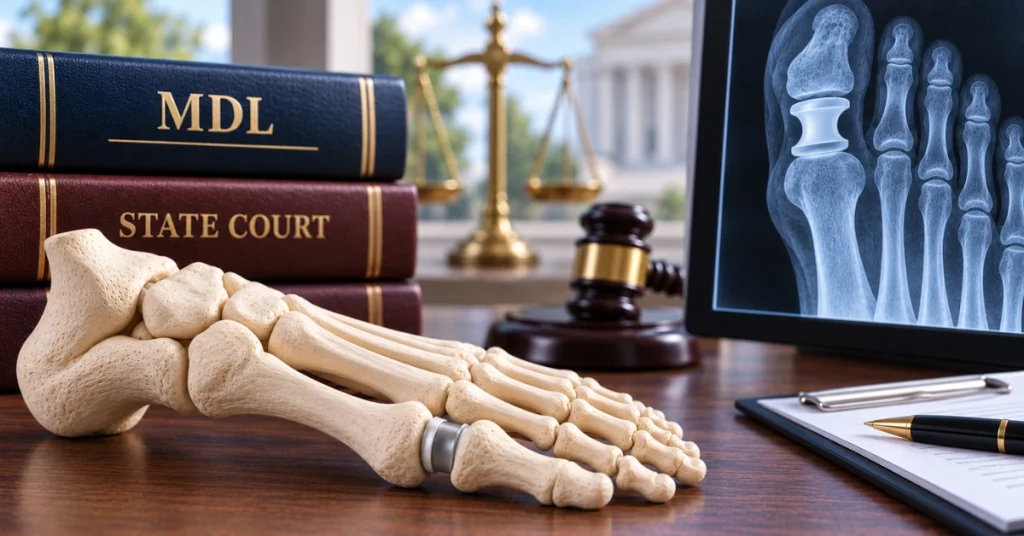
If you are considering a Cartiva lawsuit, every path leads to the same starting point: you file your own individual claim. There is no class action here, and no one signs you up for a group settlement. The real decision in front of you is venue, meaning whether your case belongs in the federal multidistrict litigation known as MDL 3172, or in a state court close to home.
That choice sounds procedural, but it shapes how your case moves. It affects who handles discovery, how quickly your claim reaches a judge, what evidence rules apply, and even how bellwether outcomes from other Cartiva cases might influence the value of yours. Getting it wrong does not end your case, but it can slow it down or put it in front of the wrong set of rules for your situation.
Baker Legal Team evaluates venue as part of every free Cartiva case review. Robert B. Baker has coordinated claims through multidistrict litigation before, including his work as State Liaison Counsel in the breast implant MDL, and he applies that same venue analysis to every Cartiva claimant who calls the firm.
What Is the Difference Between MDL 3172 and a State Court Lawsuit?
Federal Cartiva cases are consolidated as MDL No. 3172, pending in the Eastern District of Arkansas before Chief Judge Kristine G. Baker. It is worth saying plainly that Chief Judge Baker has no relationship to Robert B. Baker of Baker Legal Team. The two share a surname and nothing else.
An MDL is not a class action. Each Cartiva claimant keeps an individual lawsuit with individual facts, an individual medical history, and an individual outcome. What the MDL does is centralize pretrial work, meaning discovery, expert disclosures, and certain motions move through one court instead of being duplicated in dozens of federal courts around the country. A state court case, by contrast, proceeds entirely on its own, in front of its own judge, on its own schedule, under that state’s own procedural rules.
For a fuller look at how the MDL differs from a class action, including the docket history and the February 2026 transfer order, see our Cartiva lawsuit update.
How Does a Cartiva Case End Up in Federal MDL 3172?
The Judicial Panel on Multidistrict Litigation, a federal body created by Congress to manage exactly this kind of coordination, transferred the Cartiva cases to the Eastern District of Arkansas on February 5, 2026. Cases filed in federal court that raise similar allegations about the Cartiva Synthetic Cartilage Implant can be swept into the MDL through what is called a conditional transfer order, which moves a newly filed federal case into the consolidated proceeding without requiring the plaintiff to refile anything.
The litigation has moved past its earliest stage. Leadership counsel, meaning the attorneys who coordinate the plaintiffs’ side, were appointed following the court’s initial organizational hearing on August 26, 2026, and the next status conference is scheduled for October 8, 2026. Magistrate Judge Patricia S. Harris is assigned alongside Chief Judge Baker to help manage the day-to-day pretrial workload, which is typical for an MDL of this size. That is still early. No bellwether cases have been selected, and no trial dates exist yet for any Cartiva claim in the MDL. You can read the court’s own docket entries for MDL 3172 on the Eastern District of Arkansas’s official MDL 3172 case page.
None of this changes the fact that a conditional transfer order does not merge your case with anyone else’s. Consolidation means the evidence-gathering work happens once, in front of one court, rather than separately in a dozen different federal districts. Your medical history, your treatment record, and your individual losses still determine the outcome of your claim on their own terms. The Judicial Panel on Multidistrict Litigation, the federal body responsible for these transfers, explains the process in more general terms on its official site, which is a useful starting point if you want to understand how MDLs work outside the Cartiva litigation specifically.
A federal filing does not happen automatically just because you file in federal court. A federal case only becomes part of MDL 3172 once the Panel or the transferee court issues a conditional transfer order naming that specific case. Until that happens, a newly filed federal Cartiva case proceeds in its originating district. This is one more reason venue decisions belong with an attorney who is actively tracking the MDL’s docket, not a claimant guessing at the process alone.
What Changes If Your Case Stays in State Court?
A state court case does not automatically move anywhere. It stays in the county or circuit where it was filed unless a defendant removes it to federal court, which can happen when the case meets federal jurisdiction requirements. Absent removal, your case proceeds under that state’s rules of civil procedure, in front of a state court judge, on a schedule set by that court rather than by Chief Judge Baker’s MDL orders.
This matters because state courts vary widely in how quickly cases move, what evidence standards apply, and how product liability claims are framed under that state’s law. A claim that would sit in a large federal docket for years might reach a state court trial date sooner, or it might not, depending entirely on the jurisdiction.
How Does Discovery Coordination Differ Between the Two?
Inside the MDL, discovery is coordinated so that common evidence, meaning company records, corporate testimony, and expert reports about the Cartiva device generally, gets gathered once and shared across every case in the proceeding rather than repeated hundreds of times over. Plaintiffs in the MDL typically complete a plaintiff fact sheet, a standardized questionnaire that captures the core facts of an individual claim (implant date, complications, treatment history) in a consistent format the court and both sides can use efficiently.
A state court case runs its own discovery from the ground up. Your attorney requests records, deposes witnesses, and retains experts specifically for your case, without access to the shared discovery pool the MDL builds. That can mean more work up front for a single case, though it also means discovery is tailored entirely to your facts rather than shaped around the litigation as a whole.
Protective orders are another point of difference. The MDL enters a single protective order governing how sensitive corporate documents can be used across every case in the proceeding, which avoids the delay of negotiating that same order separately in dozens of state courts. A state court case negotiates its own protective order, on its own timeline, specific to that case. Neither approach is inherently faster; it depends on how quickly your local court moves and how many other Cartiva claims, if any, are already proceeding in that jurisdiction.
How Do Bellwether Outcomes Affect a State Court Case?
Bellwether trials are a small number of representative cases the MDL selects to try first, once the litigation reaches that stage. Their outcomes are not binding on your case, and MDL 3172 has not reached that point. No bellwether cases have been chosen as of this writing, and the October 8, 2026 status conference is expected to address scheduling for that phase rather than resolve it.
Even so, bellwether verdicts tend to influence how manufacturers and plaintiffs’ attorneys value cases generally, including cases that remain in state court. A state court claim is legally independent of the MDL, but the broader litigation landscape, including how early bellwether cases resolve, still shapes the negotiating environment your case sits in.
When Does Filing in State Court Make Sense?
Venue is not a one-size-fits-all decision. A few factors commonly point toward state court:
- Your case and the defendant share the same state of residence or headquarters, which can eliminate the diversity of citizenship federal courts require for many product liability claims.
- Your state’s damages law or statute of limitations framework offers an advantage that federal court, or the MDL’s procedural posture, does not.
- You want your case to proceed on a faster, more predictable local timeline rather than inside a large multidistrict proceeding.
Practical realities matter too. A claimant with mobility limitations from a fused or revised joint may prefer a state court closer to home, where travel for depositions or hearings is less of a burden, over a proceeding centralized more than a thousand miles away in Arkansas. None of these factors decide venue on their own. They are weighed together against the specific procedural posture MDL 3172 is in at the time your case is ready to file.
Filing deadlines are their own separate and often unforgiving issue, since a missed statute of limitations can end a claim regardless of venue. That topic deserves its own explanation, which you can find in our companion piece on Cartiva lawsuit filing deadlines.
Why This Is a Decision for Your Attorney, Not a Client’s Own Call
Venue analysis draws on jurisdictional rules, corporate citizenship, choice-of-law questions, and the current procedural posture of an active MDL, all of which shift as the litigation develops. It is not a decision a claimant should make alone, and it is not one a general practice attorney unfamiliar with mass tort litigation should make lightly either. Before you sign with any firm, our guide to choosing a Cartiva lawyer explains how to check its MDL and trial experience.
Robert B. Baker has handled product liability cases at both the individual and coordinated litigation level, including his role as State Liaison Counsel in the breast implant MDL and his record against manufacturers like Yamaha and Bombardier. Baker Legal Team reviews the facts of your Cartiva claim, evaluates where it belongs, and handles the filing either way at no upfront cost. The allegations at the center of Cartiva litigation, including claims of implant failure and the need for revision or fusion surgery, are disputed by the manufacturer, and causation has not been decided by any court. A free case review is the way to find out where your individual claim stands.
Frequently Asked Questions
Do I have to file my Cartiva lawsuit in the state where I live?
No, you do not have to file in the state where you live. Venue depends on jurisdictional rules, including where the defendant is headquartered or does business, not simply your home address. Your attorney determines which courts have proper jurisdiction over your specific claim.
Can my case move from state court into the MDL later?
Yes, a state court case can potentially move into federal court, and from there into MDL 3172, if a defendant removes it and it meets federal jurisdiction requirements. Not every state case is eligible for removal, and whether it happens depends on the specific facts of the claim.
Does filing in state court mean I lose access to the MDL’s shared evidence?
Filing in state court means your case does not automatically benefit from the MDL’s coordinated discovery process. Your attorney can still seek to use publicly available filings and testimony from the MDL, but your case runs its own independent discovery rather than sharing the MDL’s centralized evidence pool.
Who decides whether my case belongs in federal or state court?
Your attorney makes this recommendation based on jurisdictional facts, applicable state law, and the current posture of MDL 3172, then files accordingly. It is a legal determination, not a preference the claimant selects on their own.
This article provides general information about Cartiva MDL 3172 and does not constitute legal advice. Every claim is different, and venue determinations depend on the specific facts of your case. The allegations described above regarding the Cartiva Synthetic Cartilage Implant are disputed by the manufacturer, and no court has determined causation. Contact Baker Legal Team for a free, no-obligation case review.