


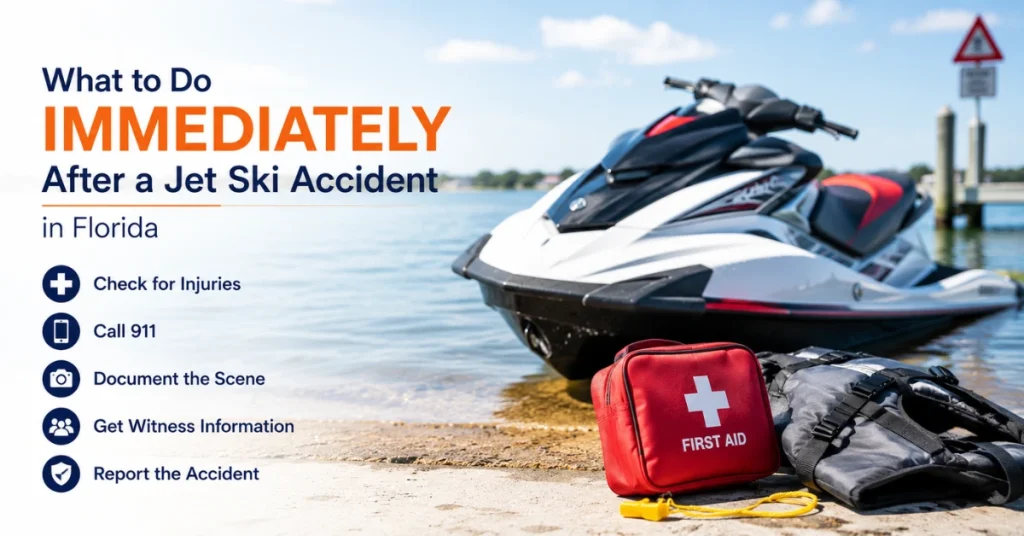
You just got off a jet ski that didn’t feel right underneath you, and now someone is hurt. Maybe it’s you. Maybe it’s your kid, or the friend who was riding behind you on a rental you booked twenty minutes ago at a beachfront kiosk. Your instinct is to fix what you can fix right now and figure out the rest later. That instinct is right about the first part and wrong about the second. What you do in the next hour after a jet ski accident in Florida often decides whether you have a case at all six months from now.
I’ve handled personal watercraft cases in Florida for more than thirty years, including the $39 million verdict against Yamaha that’s still the largest PWC verdict in U.S. history. I know what insurance adjusters look for when they try to pick a claim apart, and I know which small mistakes at the scene hand them exactly what they need. This is what to do after a boating accident involving a jet ski, specifically, and why the rental company’s paperwork matters as much as the crash itself.
Get Medical Care First, Even If You Feel Fine
Adrenaline hides pain. Riders who get thrown off a jet ski at speed can have a concussion, a spinal injury, or internal bleeding without feeling much of anything for hours. Get checked out at an urgent care or emergency room the same day, and say yes if paramedics offer transport at the scene. Beyond your health, this creates a medical record tied to the date of the accident, which matters later. If you wait three days to see a doctor because the pain built up gradually, the insurance company will argue something else caused your injury.
Florida Law Requires the Accident to Be Reported
Florida Statute 327.30 puts a legal duty on the operator to notify law enforcement without delay whenever a boating or PWC accident involves an injury requiring medical treatment beyond first aid, a death or disappearance, or property damage of roughly $2,000 or more. The statute itself lets you notify the Fish and Wildlife Conservation Commission’s Division of Law Enforcement, the county sheriff, or the local police chief, whichever you can reach fastest.
That verbal notice isn’t the end of it. A companion statute, Florida Statute 327.301, requires a written accident report within the federal timeframes set out in 33 C.F.R. § 173.55, which generally works out to 48 hours for an accident involving death or an injury requiring medical treatment, and 10 days for property damage claims of $2,000 or more. If a law enforcement officer investigates and files a report themselves, you’re usually covered without filing a separate one.
Here’s the detail almost nobody knows going into this. If the jet ski was rented, Florida Statute 327.301(6) puts the reporting responsibility on the rental company too, not just on you. That matters because it means the company can’t act like the paperwork is your problem alone. If they tell you they’ll “take care of the report,” get their contact information and follow up, because you’re still on the hook if it never gets filed.
Preserve the Jet Ski Itself
Rental companies want their equipment back in the water generating revenue. That’s normal business, but it’s also how evidence disappears. If a steering, throttle, or hull defect played any role in what happened, that watercraft is your single most important piece of evidence, and it can be repaired or rented out to the next customer within hours if nobody stops it.
- Get the identifying details. Hull identification number, make, model, and year, along with the name of the rental company and the specific unit number if one was assigned to you.
- Ask, in writing, that the unit be preserved. A short email or text message to the rental company stating that you were injured and asking them to hold the jet ski without repair or further rental use creates a record that they were on notice.
- Don’t assume the police report covers this. Officers document the accident. They rarely inspect the watercraft for a mechanical defect the way a personal watercraft accident attorney’s investigator will.
Document the Scene While You Still Can
Water accidents scatter evidence fast. Waves erase skid marks that would show up on pavement, other boaters move on, and memories fade within days. Before you leave the area, or as soon as you’re physically able:
- Photograph everything. The jet ski, any visible damage, the surrounding water conditions, your injuries, and the general area where the accident happened.
- Get witness names and phone numbers. Other riders, people on the dock, anyone who saw what happened. Witnesses on the water are harder to track down than witnesses on a highway.
- Note the time and your location. A phone’s GPS timestamp on a photo is often more reliable than memory a month later.
- Write down what you remember while it’s fresh. Not a formal statement, just notes for yourself about what the jet ski did, what you did, and what happened right before impact.
Don’t Sign Anything the Rental Company Hands You After the Accident
Most jet ski rental companies in Florida require a liability waiver before you get on the water at all. Riders often assume that waiver ends the conversation. It doesn’t. Florida courts require a waiver to be clear, unambiguous, and specific to be enforceable, and none of that language protects a company from its own gross negligence or from violations of a safety statute. If the company rented to an intoxicated operator, skipped required safety instruction, or handed you equipment with a known defect, the waiver you signed at check in likely won’t shield them from what happened after.
What I’d caution against is anything the company asks you to sign or say after the accident, separate from that original waiver.
- Incident report forms drafted by the company. These are often written to minimize the company’s exposure, not to record what actually happened. Give your own account to law enforcement instead.
- A recorded statement for “insurance purposes.” You have no obligation to give one on the spot, and a rushed, adrenaline-filled description of a fast-moving accident can be used against you later even when you’re just trying to be helpful.
- A second release or “settlement” for a refund or free rental voucher. Accepting a token gesture in the moment can complicate a legitimate injury claim down the road.
Exchange information, cooperate with the actual law enforcement report, and get medical care. Save the rest of the conversation for after you’ve talked to an attorney.
Be Careful What You Tell the Insurance Company
Within a day or two, either the rental company’s insurer or the other rider’s insurer may call to “get your side of the story.” They’re often friendly on the phone, which is exactly the point. Adjusters are trained to get you talking before you’ve seen a doctor, before you know the full extent of what’s wrong, and before you’ve had a chance to think through what actually happened.
- Give basic facts, not opinions. Confirm that an accident happened and that you’re seeking medical care. Don’t speculate about who was at fault or how fast anyone was going.
- Don’t minimize your injuries. Saying “I think I’m okay” on day one gets quoted back to you on day thirty when you’re still in physical therapy.
- Ask who they represent. Know whether you’re talking to your own insurer, the rental company’s insurer, or the other rider’s insurer before you say anything.
You’re not required to give a recorded statement to anyone else’s insurance company. Politely decline and refer them to your attorney once you have one.
You Don’t Have to Be a Florida Resident to Have a Claim
Most of the jet ski accidents I see happen to people on vacation, not year-round Florida residents. If you’re heading home to another state to recover, that doesn’t change your rights. Florida law generally governs a claim arising from an accident that happened in Florida waters, no matter where you live afterward. A free consultation can happen the same day by phone or video, and I’ve represented clients through an entire case without requiring them to fly back for every meeting. Don’t let distance from Boca Raton talk you out of calling.
Not Every Jet Ski Accident Has the Same Cause
Some of these accidents come down to a careless rider on another watercraft, or an inexperienced renter who never should have been handed the throttle. Others trace back to something built into the machine itself. If your instinct at the moment of impact was to let go of the throttle and steer away, and the jet ski kept going straight instead of responding, that’s a pattern I’ve litigated before. I go into the mechanics of that specific defect, and the manufacturers I’ve held accountable for it, in my breakdown of off-throttle steering failures.
Whether your case turns out to be operator negligence, rental company liability, or a product defect, the steps above protect your position either way. Evidence that gets preserved in the first 48 hours can prove any of those theories. Evidence that gets lost proves none of them.
Common Questions After a Jet Ski Accident
What if I was a passenger, not the rider?
Passengers usually have no control over the throttle or steering, which makes it harder for a rental company or an at-fault operator to argue you contributed to the accident. Your claim often has fewer obstacles than the operator’s does.
What if the other rider fled the scene?
Leaving the scene of a boating accident without rendering aid and reporting it is a criminal offense in Florida, not just a civil matter. Report it to the FWC or local law enforcement immediately and provide any identifying details you captured, including the watercraft’s registration number if you saw it.
Can I still have a claim if I was partly at fault?
Florida allows recovery even when you share some responsibility for what happened. Your compensation may be reduced by your percentage of fault, but partial fault on your end doesn’t automatically end the claim.
How long do I actually have to file?
Florida generally allows four years from the date of the accident for most personal injury and product liability claims tied to a watercraft accident. Certain circumstances can shorten or complicate that window, so don’t wait to find out where your case stands.
What Happens Next
I’m Robert Baker. I’ve tried more than fifty jury trials in over thirty years of practice, and I’m undefeated in personal watercraft litigation, a track record most attorneys handling Florida boating accident claims can’t match. Florida generally gives you four years to bring a product liability or negligence claim tied to a watercraft accident, though the clock and the specific rules can shift depending on the facts of your case, so don’t treat that number as a substitute for calling someone promptly.
I’m selective about the cases I take, because a defect claim against a manufacturer or a negligence claim against a rental company takes real investigation to prove correctly. Once I take a case, I handle it personally from intake through verdict. No fees and no costs unless I win, and a free same-day virtual consultation whether you’re recovering in Boca Raton or three states away. Call my office and walk me through what happened. I’ll tell you honestly what I see.